The Devil You Know: Do We Really Need HR Technology?
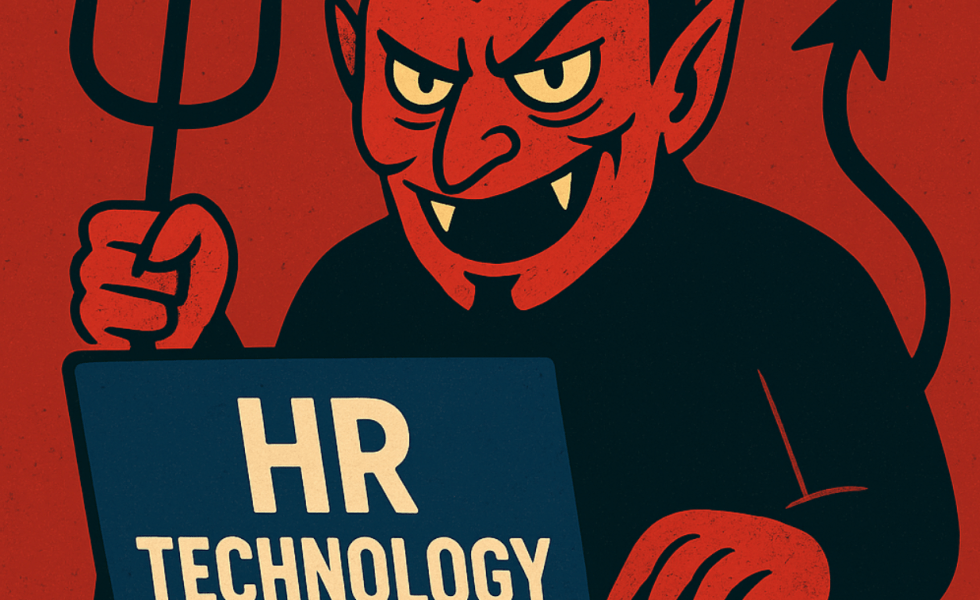
You’d think, billions of dollars and decades later, that by now, that HR would’ve figured out tech.
After all, SaaS has been the status quo for almost two decades, during which a global pandemic forced even the most analog of industries or conservative of functions to undergo an overnight “digital transformation,” which is what consultants used to call it back before it evolved from strategic initiative to tactical necessity.
Since SaaS became a ubiquitous part of our work (and our lives) back in the halcyon days of the first W administration, we’ve also undergone two major recessions, part of the perpetual, disruptive cycle of RIFs and rehiring that’s the natural byproduct of inept workforce planning and macroeconomic conditions.
We’ve seen the rise of the Gig Economy, the fall of the social contract and the collapse of DEIB as a core HR competency (unlike the first two, capitalism has no motivation to ensure its sustainability). We’ve seen the rise of crypto, the death of pensions and the dawn of general AI.
What we haven’t seen is any sort of tangible or meaningful change within the HR Technology industry, at least not compared to other categories.
This isn’t for lack of effort, or resources; the “future of work” has a long history of burning through more capital than the GDP of some countries, yet the future of work is already here. HR Technology, however, largely, remains stuck in the same rut it’s been in since the days of MySpace and Windows Vista.

Not only are the most ubiquitous solutions (applicant tracking systems, talent and performance management systems, L&D platforms, etc.) unwieldy, sluggish, janky and downright antagonistic to end users, they’re also completely and utterly incompatible with how modern enterprise employers actually operate.
The problem isn’t just that even the best purpose built HR tech is mediocre at best (with a few outliers good enough to solve other use cases, making their HR applications more or less a GTM decision than a product strategy).
It’s that the entire category is built on a false premise: that the needs of the HR function are so unique, so sacred, so specialized, that they require their own ecosystem of bespoke software.
But when you strip away the marketing jargon and compliance theater, what you’re left with is a bloated tech stack full of point solutions designed to solve problems that the rest of the business already solved; just with better tools and fewer acronyms.
Let’s call it what it is: HR tech isn’t lagging behind.
It’s running in the wrong race entirely.
The Myth of the HR Tech Stack
The idea of a standalone HR tech stack made sense in 2002, when I was in still in school and “cloud-based” still meant hosting something on-premise but calling it SaaS because no one, certainly not least capital markets, knew the difference.
Back then, the technology used in recruiting, performance management, learning, and payroll was so primitive that simply digitizing a paper process was seen as revolutionary.

Trust me. I wrote plenty of those posts over the years while at the intersection of content marketing and category creation, which is where companies have to aim when they don’t have a viable product but have a boatload of VC money to answer to.
Fast forward to today, and most business functions, from sales to marketing, from finance to procurement, have largely evolved beyond function-specific software silos.
They use composable, API-first platforms that integrate into the broader business architecture. CRMs talk to ad platforms. Project tools talk to finance. Everyone’s in the same digital ecosystem.
Except HR. HR is still out here building middleware to support a half-dozen overpriced “best-of-breed” vendors that don’t integrate, don’t scale, and don’t do anything you couldn’t already do in Airtable or Notion.
This fragmentation isn’t just annoying. It’s expensive. A recent study from Sapient Nitro found that the average organization maintains over 11 separate HR systems across the employee lifecycle, many of which duplicate functionality or rely on manual workarounds just to function.
And that’s before we even talk about the data standardization and migration, compliance risks,, expensive and time consuming implementations and way too much internal change management that are requisite whenever a company decides to cobble together a bunch of crap enterprise bloatware and refer to it as a “stack.”

At a time when companies are laying off recruiters and consolidating headcount, continuing to buy bespoke tools for siloed workflows is not just inefficient; it’s indefensible.
The Composable Enterprise Is Here. HR Missed the Memo.
In every other part of the business, software has moved toward “composability” – modular systems that plug into each other, adapt to new use cases, and evolve alongside the business. Gartner called this the “Composable Enterprise” all the way back in 2020.
Lest you think this is just another hype cycle, McKinsey followed suit the following year, noting that modular tech stacks enable companies to respond to disruption 2x faster than those reliant on monolithic systems. Even the World Economic Forum recognizes tech interoperability as a pillar of “business resilience.”
But what the hell do they know? They’re not even SHRM certified.
Because HR, in its infinite wisdom, still builds tech stacks like it’s got an Allen wrench and some particle boards from Ikea but no instructions – futilely trying to assemble the promised end product, but unable to understand what the various pieces are and how they fit together.
Only, in this scenario, the material costs are at least 10x more, the Allen wrench is under a professional services retainer, and whether or not you finally figure out how to build that Scandinavian sectional, it’s the only one you’re contractually bound to have in your house for the next three years, minimum.
Caveat emptor.
A lot of this comes down to commoditization; rather than adopt shared tools or frameworks already used elsewhere in the business, HR insists on constantly reinventing the wheel – and there’s always a willing, VC backed vendor there to “help” them find the next best thing, even when it’s almost always the same old shit.
Want to securely send confidential or proprietary information, like a job offer or new employee paperwork?
Your vendor would tell you that you’re just asking for a security breach using Docusign or Google Forms, which is why you need a full “digital onboarding solution” that charges you a license fee not only for every seat, but also for every document.
It’s f-ing absurd, bruh.
Want to track applicants? A relational database like a CRM would totally make sense, but of course, you can’t just use the same instance of Hubspot that’s already implemented, configured and optimized elsewhere in the business.
No, my friend – you need a “recruitment CRM,” which is basically a Salesforce object with a LinkedIn plugin and a UI that hasn’t been updated since about the same time as Obama was first elected. Forget that after Salesforce, the largest CRM vendors are…Microsoft, Adobe, Oracle and SAP.

I know, it’s ridiculous to think these providers would ever dabble in the esoterica of HR Technology, but stay with me a second.
The more absurd part is the fact that these products almost uniformly deliver a worse experience than their non-HR counterparts.
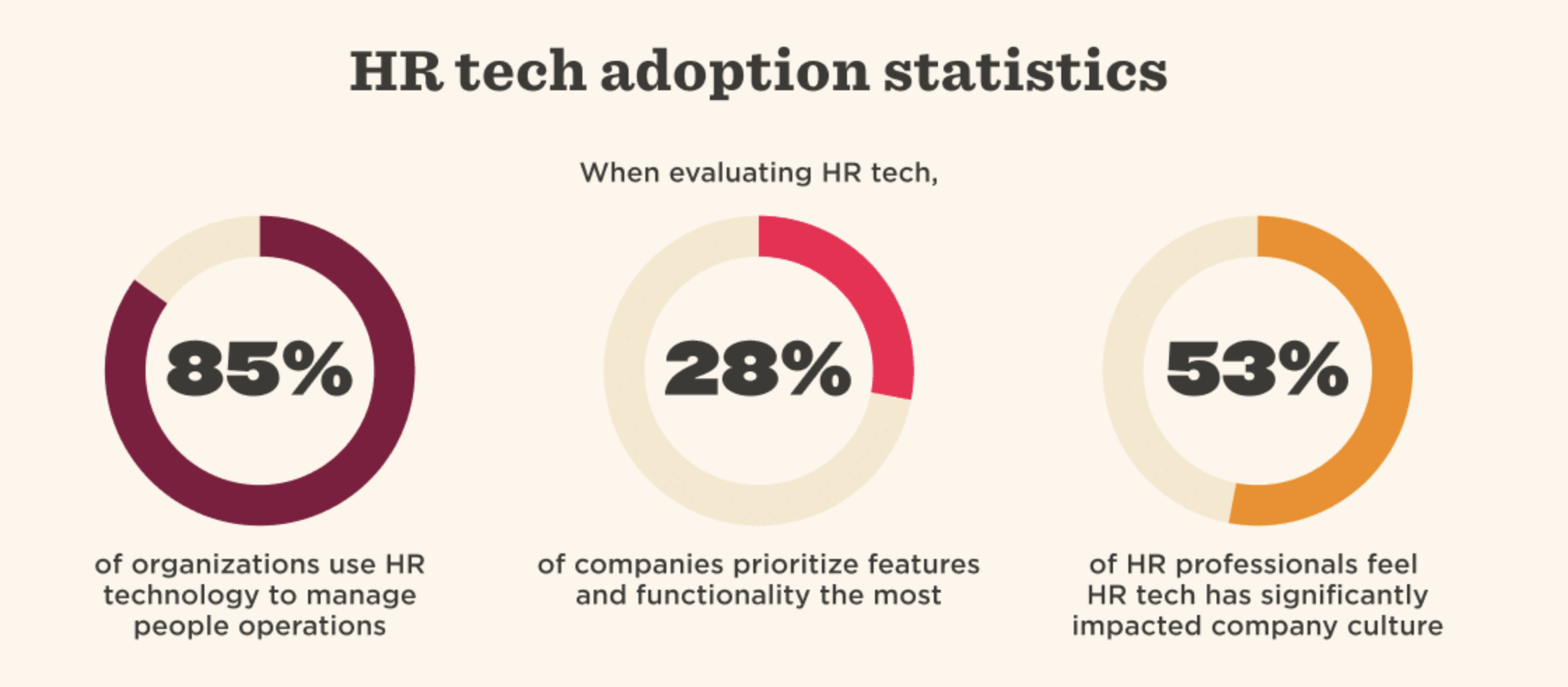
According to a 2024 Deloitte Human Capital Trends report, only 27% of HR leaders say their technology delivers a “positive user experience” for employees.
That’s not just bad; It’s a failing grade (or proof that only 83% of HR leaders have any modicum of self-awareness around technology adoption or utilization, which frankly, sounds a bit high).
Compliance Is Not a Product
The most persistent excuse for sticking with purpose-built HR tech is compliance. Almost every HR Tech vendor promises compliance as not only a SaaS selling point, but as a competitive differentiator.
“We need SOC 2,” say HR vendors. “We’re GDPR-compliant.” “We help you manage EEOC reporting.”
Great. So does literally every B2B SaaS platform with a cap table and a LinkedIn page. The idea that compliance is something only HR Tech can handle is a lie vendors use to justify high prices and proprietary workflows.
In reality, most compliance standards are squarely focused on process, not platform; employment law remains, for now at least, refreshingly platform agnostic.
Compliance is just as easy with, say, Apollo or Customer.io as it is with a purpose built HR Tech solution like a Gem or a Phenom that share pretty much the exact same use case,, as long as solid processes are in place, along with appropriate controls and institutional oversight.
Conversely, if your process is crappy, or without those basic checks and balances in place, you could be using a heavy duty ERP like Workday or ADP (God help you) and totally out of compliance.
And let’s be honest. If your HR team is relying on their HR Tech provider to keep them compliant, your company has bigger problems than software selection.
Follow the Money, Find the Roadmap
This isn’t just about technology. It’s about incentives.
The HR tech industrial complex (yes, it’s a thing, and they have a trade show quickly approaching) traditionally runs on fear, uncertainty, and doubt. Vendors don’t want you to realize that you can run most of your recruiting ops out of a CRM and a Google Sheet.
Or that you don’t need a six-figure learning management system when most people are just watching YouTube tutorials anyway. Or that your CFO could replace half your “people analytics” dashboard with a well-built Looker report and a few shared metrics.
The result is a market where HR buyers are conditioned to spend more for less—less flexibility, less usability, less integration, less insight. A recent IDC report pegged global HR tech spending at $14.8 billion, and is expected to surpass $60 billion (that’s billion, with a B) by 2028.
That’s more than the entire market capitalization of Box, Asana, HubSpot, and Zapier combined.
Think about that.
We’re not paying for innovation. We’re paying for the illusion of control.
What The Best Employers Are Already Doing
The smartest HR teams aren’t buying more HR tech. They’re buying less of it, and making it work with the rest of the business.
They’re using the company’s existing CRM to manage candidate pipelines. They’re integrating onboarding tasks into the same project management tools the rest of the org uses. They’re embedding learning into Slack and Teams instead of shoving people into legacy LMS portals. They’re using product analytics to measure engagement instead of relying on HR dashboards no one trusts.
They’re not trying to force HR to act like a tech buyer. They’re treating HR like a business function—one that deserves the same quality of software, the same access to data, and the same level of agility as every other part of the company.
And guess what? It works.
A 2024 Gartner report found that organizations with “connected talent architectures” (those that integrate HR into the broader tech ecosystem) are 2.3x more likely to exceed revenue goals and 3.1x more likely to outperform peers in innovation.
This isn’t a theory.
It’s a competitive advantage.
Stop Buying for HR. Start Buying for the Business.
The future of work isn’t going to be built on 20-year-old applicant tracking systems and performance portals with a “gamified” UI (barf). t’s going to be built on platforms that are open, flexible, and designed to integrate, not isolate.
The longer we pretend HR is a special little snowflake that needs its own unique software sandbox to play in, no matter what the justification du jour happens to be, the fact is that we’re simply delaying the inevitable: a world where recruiting is just pipeline management, onboarding is just task automation, learning is just content delivery, and performance is just data.

The best tech for HR isn’t “HR tech.” It’s the best tech, period.
So the next time a vendor pitches you a purpose-built HR point solution with a “proprietary interface,” a contract for three years, and an MSA that provides an implementation timeline that last months instead of days, ask yourself a simple question:
Would marketing buy this?
Would sales?
Would engineering?
Hell no.
Then ask yourself: why should HR? We both already know the answer.
 Snark Attack
Pingback: Why Your Recruitment Advertising Sucks. | Snark Attack
Pingback: When Dinosaurs Ruled: Why the OpenAI Jobs Platform Could Be An HR Tech Extinction Event | Snark Attack