Where We’re Going, We Don’t Need Roadmaps.

There’s a running joke in recruiting tech that every five years, the industry just puts a new buzzword on the same old pitch deck.
In the mid-2000s, back in the Certified Internet Recruiter days, it was “web-based,” then its groundbreaking derivative, “cloud enabled.” Sometime around 2010, the conversation shifted to “social recruiting.” 2015 marked the rise of “big data,” By 2020, we were all in on “DEIB.” Until, of course, we weren’t.
Now, we’re in the age of artificial intelligence, which, for most enterprise HR Tech vendors, means frantically bolting ChatGPT onto a 15-year-old code base and praying nobody notices the fundamentals still suck.
Among these legacy vendors making the shift from applicant tracking to artificial intelligence is iCIMS, a company whose very name, shorthand for “Internet Information Management Systems,” feels as outdated an anachronism as “mobile recruiting,” building Boolean strings or the latest version of Taleo Business Edition.
As its brand name seemingly suggests, iCIMS has long been a technology that CHROs tend to love and recruiters tend to tolerate, the Goldilocks of the ATS ecosystem: not too hot, but not too cold, either.
Maybe it’s not just right, but it’s certainly better than most of its upmarket incumbents, although lacking many of the features and functionality of more recent market entrants.

To hear newly minted Chief Product Officer Eric Connors tell it, however, iCIMS isn’t just jumping on the AI bandwagon or riding the hype train to larger deal sizes and bigger contracts. In fact, hey’ve been “in the AI business…for so many years,” says Connor, thanks to their pandemic era acquisition of Opening.io, at the time, a cutting edge, yet largely untested, Irish startup founded by my good friend and erstwhile genius, Andreea Wade.
That product was initially marketed as “iCIMS Talent Logic,” and it was, at the time, one of the first concerted attempts by a legacy ATS vendor to position AI at the forefront of its competitive differentiators and platform capabilities. As former iCIMS CEO Steve Lucas said at the time of the acquisition, the company was “excited to demonstrate iCIMS position as an innovative leader in AI for talent,” at a time when that was more aspirational novelty than a hackneyed cliche.

“We had been in the AI business, like real production AI to customers, for so many years. That was… somewhat unique,” Connors said.
Translation: while everyone else was talking about “machine learning,” iCIMS was already trying to make matching suck less. Of course, at the time of the Opening acquisition, Lucas also declared that the technology would be truly transformative, declaring:
“I’m excited for our customers to reap the benefits of industry-leading machine learning coupled with an unrivaled data set – including shorter times to hire, lower costs to hire, and identification of the best talent to transform their workforces.” – Steve Lucas, iCIMS CEO (May 14, 2020)
So far, this hype has been far from substantiated, but being an early entrant has significant advantages in AI, and its one iCIMS seems increasingly intent on leveraging. Five years later, the company is assuring the market that its initial vision of AI and aggregated data is finally coming to fruition.
That they’re using messaging and positioning that seem nearly indistinguishable from that press release in May 2020 seems besides the point. The proof, iCIMS says, is in the product – one that, according to Comperably data, currently sits slightly below that of Workday with an NPS of 26 (although over twice that of UKG or Oracle).
Prior to their acquisition of Opening, iCIMS also acquired SMS automation provider TextRecruit in 2018, although according to a summary of online product reviews,
“iCIMS provides mobile recruiting capabilities and a dedicated mobile app, but the overall user experience on mobile may not be ideal for all users. While some users find the mobile features useful for certain tasks, others may find the user interface and functionality to be lacking compared to the desktop version.”
Good thing AI is way, way easier to optimize for than mobile devices.
It’s also worth noting that in the five plus years that they’ve been evangelizing AI, iCIMS, already owned by private equity firm Vista, announced a subsequent investment by TA Associates to help iCIMS‘ “further penetrate the $17 billion market for talent software.”
This influx of institutional capital is generally not a positive sign for companies built on product led growth or innovation, but iCIMS and their ownership insist that their “ability to leverage the [enterprise software] ecosystem” continues to create “value for our companies and our Limited Partners.”
“We have added a ton of features and capabilities around what, at the end of the day, is just putting data into a database, “Connors said. “AI really gives us the opportunity to take a step back and say, like, what does the human have to do? And how can we get rid of all that stuff in the middle?”
That “stuff in the middle” is the proverbial Frankensuite endemic to so many enterprise TA tech stacks: dozens of clicks, way too many required fields, and integrations that break more often than a five buck bong.
AI could theoretically reduce this operational complexity ; the issue, of course, is that most vendors will just use these capabilities to create additional complexity and fragmentation to an already broken process, doing little to augment or expand core functionality or improve user interface and experience – but hey, at least they have a chatbot now.
Excuse me. “Conversational Intelligence” (barf).

Unlike the “move fast and break compliance” crowd, iCIMS has actually built a Responsible AI program that, upon closer inspection, indeed seems to represent more than just a perfunctory ethics slide in a glossy sales deck. They’ve built governance structures, run bias detection on “every build,” and mandate ethical AI training for everyone in their product organization.
They even got a TrustArc certification — which in vendor land is basically the equivalent of getting a gold star for coloring inside the regulatory lines. It might not be perfect, but it’s a start.
“Our primary idea is that AI is something that is used to assist the user. It’s not designed to make the user decision,” Connors says.
That’s a subtle but important point: iCIMS’ AI won’t “auto-reject” candidates, hide resumes, or decide who gets hired. You still see every match, and you get to know why the algorithm thinks Candidate A is better than Candidate B.
Which is more than I can say for a few vendors in this space who’ve built the machine learning equivalent of “shut up and trust us.”
Data Lake of Fire: Moving From “Workflow” to “Agentic”
Like every ATS, CRM or relational database out there, iCIMS talks about its “data set” like it’s some sort of strategic advantage. And to be fair, with thousands of customers and millions of candidates, it does, in theory, represent a competitive advantage for iCIMS (as long as they can keep the privacy regulators happy).
Of course, all that data still isn’t as reliable an indicator as a good old self reported survey designed by an independent analyst firm with little to no relevant domain experience, which is where iCIMS’ latest monthly Workforce Insights Report comes in.
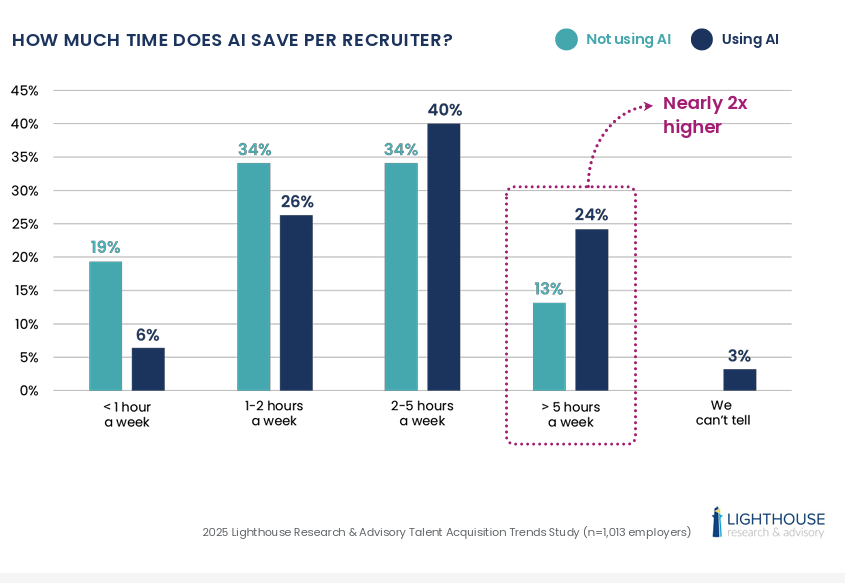
Connors was quick to highlight the results of this customer survey designed as a research report, particularly a benchmark stat that also makes for a pretty compelling business case: 55% of employers using AI in recruiting (beware round numbers in survey results) say that it saves them at least two hours a hire, with some respondents reporting time savings of up to five hours, on average.
Theoretically, these hours represent a tranche of time that can be spent talking to candidates, building relationships and better aligning with bigger business initiatives and strategies.
But – (here’s where the cynicism kicks in) – those numbers assume you’ve got your workflows and data infrastructure properly sorted. Feed trash into any LLM, and you just get the same garbage back, only faster.
Connors even admits some vendors lack the “discipline” to choose the right approach to data collection and analysis, instead cramming everything into their proprietary large language model because it’s trendy (or, more accurately, saleable).
Bots Like Us
Like so many other HR Tech vendors, the next big thing in iCIMS’ roadmap is “agentic” AI – autonomous agents that can theoretically execute multi-step processes, like sourcing candidates for a role, without end user intervention.
Connors explains iCIMS’ agentic sourcing capabilities (which sound a lot like those offered by CandidateID, another iCIMS acquisition, out of the box) like this:
“You decide for which job you want to invoke the agent… Do you want me to automatically look for candidates? Yes. How many? 50. Do you want me to invite them to apply? Yes. Then it gives you status… You can stop it at any time.”
That’s a refreshing level of opt-in control in a market where some vendors think “agent” means “AI that starts doing things while you’re stuck on Zoom calls all day and hoping you like the results,” a veritable black box of black magic.
Here’s how iCIMS compares against its peers:
- Greenhouse: They’re obsessed with still trying to make structured interviewing (or DEI dashboards) a thing; Greenhouse is great at being prescriptive in telling you where your process sucks – and often why. It’s a little less great at doing anything to actually make that process better. While they vocally tout their AI capabilities, to date, most are delivered through partners.
- Lever: Another private equity pickup, Lever, designed to be the Google of applicant tracking systems, is now part of Employ – the island of misfit ATS acquisitions (or “intelligent hiring suite,” in their words) stitched together by PE shop K1 to offer essentially the exact same solution to different size businesses at different price points. Lever reportedly offers a best in class solution for re-engaging passive candidates using predictive CRM data, but too often, their algorithm is “predictive” in the same way that GMail is predictive when it suggests you finish every email by signing off with “Sounds good.”
- Jobvite: Built with “social recruiting” at its core, Jobvite has shifted its product marketing to focus on a more topical set of buzzwords. Another Employ marque, this K1 imprint promises native “intelligent automation” throughout its platform, which is essentially a bunch of point solutions packaged with a rubber band, something that shows in its AI capabilities. Its features often feel like leftovers from some other vendors’ skunkworks – superficially interesting, but not necessarily aligned with business needs or realistic use cases.
- SmartRecruiters: The loudest AI marketer of the bunch, SmartRecruiters has gone from being the “Hiring Success Company” to “AI Powered Software for Superhuman Hiring,” which apparently involves a multiverse full of generic job ad generators and a library stocked with templates for candidate comms. As an independent entity, SmartRecruiter has taken several big swings at AI, but their seemingly heavy reliance on GPT-style integrations and API calls means that the sizzle would have almost inevitably outlasted the steak – that is, until SAP swooped in. The combined entity represents a major wild card – one with a significant amount of market momentum and resources behind it.
This list is obviously incomplete, however, it’s a pretty representative snapshot of erstwhile iCIMS competitors representing what could be considered the second generation of applicant tracking systems. Compared to this lineup of upstart brands turned enterprise incumbents, iCIMS’ approach (at least their product marketing materials) seems to be less focused on splash or sex appeal, and more about shipping AI features recruiters use every day, focused more on the ends than the means.
And in recruiting, this all comes down to the only thing that really matters: making better hires faster.
Artificial Intelligence and Reality Checks
After talking ad infinitum about the manifold use cases for AI, Connors turned candid about the guardrails governing iCIMS, declaring that even this platform panacea has some inherent limitations:
“The actual hiring decision… I don’t think AI should decide this is the best candidate. The recruiter’s got to be involved in creating the offer… That relationship is a key component.”
In other words, if it’s a moment where a human touch matters – making an offer, handling a counter, explaining why the benefits package doesn’t actually suck, or negotiating a final salary or start date – iCIMS leaves that to the recruiter.
Which, frankly, is the opposite of the “fully automated hiring” fantasy some vendors are still trying to sell.

One of the more telling points from the August Workforce Insights Report is that 37% of TA leaders say their ATS is “more complex to use” since AI features were added. That’s the dark side of this hype cycle: complexity creep disguised as “innovation.”
Connors’ own admission that “enterprise software providers are the guilty parties in terms of creating those steps” is rare self-awareness for the category.
The question is whether iCIMS can actually resist the temptation to add more AI bells and whistles at the expense of recruiter sanity.
The ATS vendors who win the AI era won’t be the ones with the splashiest “agentic” demos or the most LinkedIn ads. They’ll be the ones who quietly make hiring less painful without making recruiters learn a new system every quarter.
If iCIMS sticks to its guns, and keeps building AI that assists, creating data governance that’s more than marketing, and optimizing workflows and processes that put recruiters in control – they might actually pull it off.
The rest? Well, as Connors put it:
“We’re trying to keep it real.”
And in a market this drunk on hype, that might be the most radical AI strategy of all.
 Snark Attack
Pingback: Beyond the Frankenstack: How to Choose the Right AI Partner for Hiring | Snark Attack
Pingback: Video Interviews Evolve: Zoom’s Strategic Move with BrightHire | Snark Attack