Dayforce’s Big Recruiting Bet: Agentic AI, Frontline Hiring & The Future of Talent Acquisition Technology

I don’t go to many user conferences, and I write about even fewer. Spend a few days inside a single vendor’s universe (particularly if analyst briefings are involved) and you tend to learn a little too much about how the sausage gets made, or how the clickable demo doesn’t.
The format doesn’t help, either: companies with already staggering margins charge their own customers to sit through product propaganda so on the nose that Leni Riefenstahl might suggest dialing it back a notch, with most of the stage time reserved for the biggest logos and the loudest evangelists.
Last week, though, I found myself in Las Vegas at Dayforce Discover, which, for someone with almost no history with the company, turned out to be a fitting name. Dayforce rarely comes up in talent acquisition conversations, so I walked in with no relationships with the executive team and no real preconceptions about the product, which is a rare position for someone who spends most of his days listening to customers vent about their vendors.
I walked out cautiously optimistic, which is rarer still. Dayforce is making an overdue but credible bet that recruiting belongs at the center of its platform, and it has a couple of structural advantages that most vendors making the same bet don’t.
Whether it can turn a roadmap into results before its new private equity overlords get restless, as we’ve seen, is another question entirely. As yet, it’s quite literally a (multi) billion dollar question.
Dayforce Discover, Under Deliver?
Dayforce has stayed off my radar for a simple reason: it never really invested in talent acquisition. It’s long had an ATS, of course, but one Dayforce executive described it to me as “good enough,” which in recruiting, never actually is, particularly when you’re a legacy provider up against best-of-breed vendors whose entire engineering and go-to-market capacity is pointed at recruiters, rather than at HR generalists who happen to make the occasional hire.
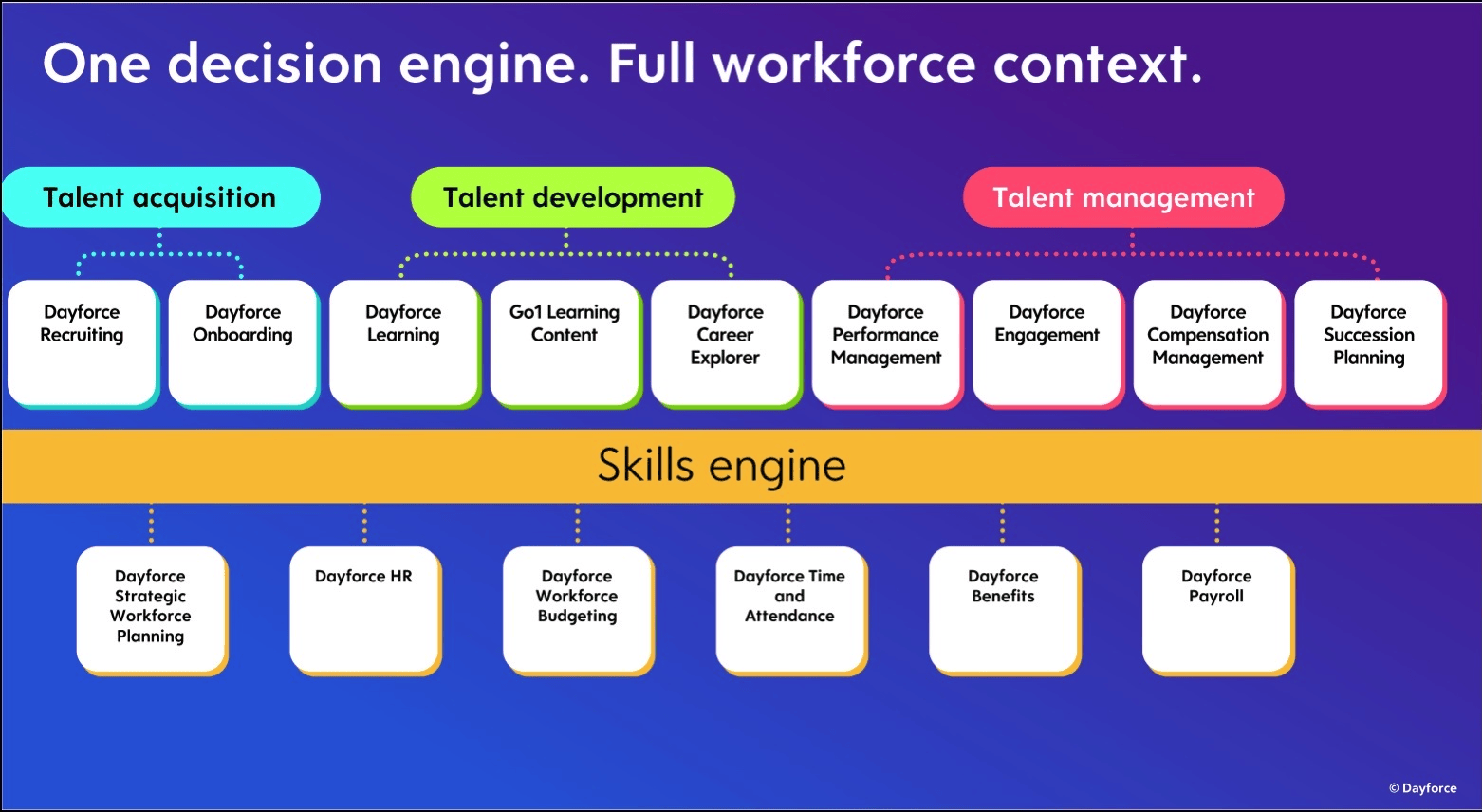
That’s a strange blind spot for a company whose whole pitch is consolidation. Dayforce sells a single code base, a consistent interface and standardized data across a suite its marketing team describes, repeatedly, as running from “pre-hire to post-retire.” For most of its history, though, the “pre-hire” part was more of a rhyme than a product. It’s still a pretty cringeworthy tagline, if we’re being honest.
What makes the strategic shift worth covering (relatively speaking, of course) is what happens if its workflows actually work. Today, candidate data mostly dies when the req closes and the new hire’s record moves from the ATS into the HCM, which is a big part of why measuring quality of hire remains such a Quixotic exercise; the recruiting data and the performance, scheduling and payroll data that would tell you whether a hire was any good live in different systems owned by different teams.
A recruiting product built on the same data model as time, attendance and performance could close that loop, starting with the lowest-hanging fruit, like whether new hires show up for their shifts and stick around past their first pay period.
Plenty of suites have promised this, of course. Most turned out to be a proverbial Frankenstacks (yeah, I hate that naming convention, too), stitched together through acquisitions whose code bases never fully agree with each other, and the few exceptions tend to treat recruiting as an afterthought.
Dayforce, which built its platform on a single data model, has a better shot than most at delivering the connective tissue, and it laid out a credible vision for doing so at Discover, provided you can separate what ships today from what got “previewed” (which, at any user conference, is always the trick).
Dayforce Recruiting: Shift Happens
The rebuilt Dayforce Recruiting is aimed squarely at frontline and high-volume hiring, which drops Dayforce into an arms race for a market that spent decades being ignored and is now one of the most crowded corners of HR tech, mostly because vendors figured out that hourly hiring is where both the promise and the limits of AI show up fastest. The feature list unveiled at Discover reads like an enterprise RFP checklist: an integrated CRM, segmented talent pools you can message, configurable workflows, contingent staffing coordination and, of course, agents to automate sourcing and scheduling at the front of the funnel.
None of it has actually shipped – yet. The product remains in development, with general availability expected sometime in 2027. If you’re a Dayforce customer, that means the wait for a modern recruiting product is nearly over; if you’re an objective observer, the more interesting question is why it took this long. And if you need something you can deploy today, you should probably keep shopping, because a beta can’t cover a double shift on a busy weekend.
Still, the operational focus is right. In high-volume environments, minor process failures compound into recurring problems in a hurry. A hiring manager who waits two days to schedule an interview for an exempt role causes, at worst, a minor inconvenience.
Repeat that same delay across a few hundred locations, though, and you’ve got a staffing shortage that hits revenue well before it shows up on any recruiting dashboard, which is exactly the kind of problem a platform already running those locations’ schedules and payroll should be able to spot first.
Agentic Recruiting > Agency Recruiters
The CRM is more catch-up than differentiator, but it should still cut a lot of waste, since most employers keep paying to reacquire candidates whose data they already own. Turning those talent pools into meaningful candidate engagement, and doing so at scale, is way harder than it sound; even the myriad vendors who do nothing but recruiting CRM have struggled to crack the code around this capability (looking at you, Beamery).
Dayforce also has more to lose than most if this pivot doesn’t work. A company that likes to tout 98% customer retention can’t really afford a recruiting product that underwhelms its install base, and in high-volume hiring, value gets measured in cost per fill. If the new product doesn’t move that number, all that ROI-heavy go-to-market messaging starts writing checks the product can’t cash.
The most differentiated thing I saw was native contingent workforce and staffing agency management. Hourly employers lean far more heavily on temp and contract labor than their salaried counterparts do, and pulling vendor management into the system of record (instead of routing it through an MSP and a separate VMS) could produce real, immediate savings, given the margins many staffing firms enjoy. It also reflects how frontline work actually happens.
A general manager trying to cover a Saturday doesn’t care whether the newest warm body came from an “agentic, AI-native platform” or a temp agency still running on paper timecards, and software that accommodates that messy reality has a built-in advantage over systems that force multi-unit operators to bend around HR processes designed for salaried employees.
Ribbon Acquisition Comes With Strings Attached
The asterisk on my optimism is Dayforce’s first recruiting acquisition since going private. On October 23, the company agreed to acquire Ribbon AI, a Toronto startup whose voice and video interviewer (along with its sourcing and outreach tools) will be integrated natively into the new recruiting product once the deal closes. Ribbon is young by most standards, although by AI interviewing standards it’s practically a legacy vendor; Greenhouse bought Ezra AI Labs, which was founded in 2024, this spring.
The trouble is that Dayforce is doubling down on a feature nearly every competitor already offers, and Ribbon’s integrity checks, which flag unusual audio, gaze and response timing, make more sense for remote knowledge work than for a warehouse that will meet the candidate in person on day one.
The proof points are the usual ones: hundreds of customers, more than a million completed interviews and rediscovery tools tested across as many as 30 million candidates in a single ATS, a claim that’s also true of Taleo Business Edition, and one that’s every bit as specious, too. Volume tells you how often a bot talked to an applicant (or, increasingly, to another bot); it says nothing about whether anyone worth hiring actually got hired.
The detail buyers should notice is that Ribbon generates its questions and scoring rubric from the job description and “relevant past interviews,” and roughly 90% of its customers run the recommended default configuration. That’s great for speed to deploy, but it means most employers are scoring candidates against a rubric they didn’t build, derived from past decisions that may or may not have been any good.
Before buying in, ask whether the scoring has ever been validated against performance in a shift-based role, what happens when a qualified candidate needs an accommodation, and how easily a hiring manager can override the bot.
There’s some credible evidence that generative AI can actually improve work, as long as that work is relatively niche and narrowly focused. A Quarterly Journal of Economics study of AI use within customer service organizations, for example, found intelligent assistants and agentic capabilities raised issues resolved per hour by 15% on average, with the biggest gains among less experienced workers and slight declines in quality among the most experienced.
Answering billing questions faster doesn’t prove a bot can judge human potential, of course, but it shows what real evidence looks like: a specific intervention, a measured result and an explanation for where the gain came from.
AI interviewing vendors deserve the same standard, and here’s where my optimism creeps back in. Dayforce owns the scheduling, attendance, performance and payroll data on the other side of the hire, which makes it one of the few vendors that could actually test whether a bot interview predicts anything at all.
Whether it bothers to do so will tell us more about Dayforce as a recruiting contender than any executive presentation or product marketing collateral.
Watch What Happens: Thoma Bravo Doubles Down
The other takeaway from Discover is that the artist formerly known as Ceridian is no longer a mid-cap public company trying to keep pace with bigger suites. Thoma Bravo closed its $12.3 billion take-private in February, a move Dayforce’s own executives seemed to suggest was the only viable path for a mid-tier HCM provider in a consolidating market.
The deal was announced on August 21, 2025, the same day Workday said it was buying Paradox and only weeks after SAP agreed to buy SmartRecruiters, and in a briefing with analysts at the event, Ossip implicitly acknowledged the competitive pressure those deals represent.
All three suites are now making versions of the same bet, albeit each are pursuing their respective strategy from radically different starting points. SAP bought a recruiting platform to effectively replace SuccessFactors, while Workday has spent two years arranging a handful of strategic acquisitions around its own recruiting core.
Dayforce, by comparison, is choosing to rebuild their native recruiting instance using its existing code base and capabilities, a strategy which necessitates the occasional acquisition of specialized pieces and point solution providers when the rubber meets the roadmap. None of those approaches wins automatically; owning a company’s historical payroll or performance data, for instance, has never, on its own, made any organization any more efficient or effective at hiring.
What Thoma Bravo really changes is Dayforce’s appetite for acquisitions. Private equity has spent years buying HR tech providers for their distribution and revenue, then rolling up the capabilities they can’t build fast enough (see Vista and iCIMS, K1 and Employ, TPG and Greenhouse, or Clearlake and Cornerstone), and in most of those portfolios, “innovation” became something of a shibboleth for ancillary revenue streams. It’s an expensive way to buy a roadmap, too: when Workday bought HiredScore in 2024, it booked $409 million of the $530 million purchase price as goodwill, which is accounting’s polite way of saying “trust us.”
So expect Dayforce to buy wherever buying closes a gap faster than building. If I were handicapping it, I’d watch skills intelligence, job-relevant assessment and industry-specific staffing technology, possibly even an embedded RPO play built around candidate delivery instead of candidate discovery.
Those are my hypotheses about product fit, by the way, not rumors or inside information (although, Dayforce, if you’d like specific recommendations, you know where to find me). The best additions will make the link between hiring and workforce operations more tangible; overlapping features will mostly provide job security for integration consultants and a lot of risk for whichever HR leader gets stuck managing the implementation.
My guarded bet (yes, I’m being optimistic, and am aware that’s pretty out of character) is that Dayforce has the right thesis for approaching talent acquisition, combined with the operational data required to test it. Whether it has the patience to do that testing with a private equity clock running, however, is something that every customer might think about paying attention to; turns out, even the companies selling HR tech have decided that acquiring talent is easier than developing it. It’s a lot more expensive, too.
Of course, if you’ve ever led a talent organization or worked in a recruiting function, you probably already knew that.
Great post Matt. You mention staffing agency/RPO inputs and recycling existing talent pools, but what other raw talent inputs does Dayforce or similar ATSs have? From what I’ve seen, they connect to the duopolists which provide candidates on demand (P4P) but they only represent ~50% of the US talent pool and much less globally speaking. High-volume hiring gets the headlines but there are still plenty of roles that are not commodities.