Why Career Sites Are the Future of Recruitment

There was a time, not that long ago, when owning ‘career discovery’ was dominated largely by job boards, a “feature” that was less core product functionality than SEO strategy, a convenient way to drive more traffic – and higher ad rates – by targeting ‘passive’ candidates exploring career development as opposed to active applicants browsing active, open roles.
This process was relatively simple and straightforward – you bought more targeted traffic than the competition, designed the UI/UX around conversion optimization, and hoped to drive enough sign ups and applies to their associated ad inventory to keep customers’ pipelines packed with high intent, career focused, highly niched professionals.
This approach wasn’t particularly complicated – and, largely, this approach has historically worked fairly well, sort of like a CAPTCHA for careers. This focus on career development as a shibboleth for job ads, in fact, was the business model that allowed behemoths like Glassdoor and LinkedIn to successfully scale in an otherwise overcrowded, cutthroat market for job seeker traffic.
Those days, however, are quickly coming to an end. As talent acquisition evolves, the structural changes are forcing a fundamental shift in not only how career discovery works, but also, who owns this foundational human capital function, too.

And like so much in recruiting today, this shift is being driven largely by AI (yeah, I know – but here, its impacts are far more subtle than most erstwhile ‘disruptive’ use cases and challenger brands). In as much as career discovery has long been one of the parts of the hiring process that everyone seemed to overlook largely because of its simplicity and ease of automation (get click, capture candidate, monetize intent), it’s starting to become less table stakes for vendors and more of a strategic imperative for internal recruitment teams themselves.
That’s because the foundational currency of career discovery – the all important ‘click’ – is becoming increasingly optional, and ultimately, dispensable.
The Search Box Had a Good Run
This evolution is being driven largely by shifts in the candidate journey; rather than starting with a search engine, candidates are starting career discovery directly within LLM-driven answer engines, like Chat GPT or Claude.
Instead of typing keyword soup and short tail queries into a search box that hasn’t meaningfully evolved since 2008, they’re asking actual questions using natural language leveraging tools that are, largely, vendor agnostic.
Some of the most common career queries, according to SEMRush data, are pretty intuitive: they’re asking what type of job they should look for next to advance their careers, what sorts of roles they qualify for, relative market demand and competitive landscape for these careers, how much they should be making, and which employers offer their ideal work-life balance, company culture or total rewards (or, often, some combination thereof).
As the candidate journey rapidly reroutes, AI is becoming the default departure point not for transactional job search, but for the entire category of career discovery – and consumer AI platforms deliver the answers to their most pressing career questions well before those candidates ever hit a job board, company career site, recruitment marketing content or employer branded collateral.

If you’re a job board operator, this shift presents something of an existential crisis; similarly, if you’re a talent acquisition leader, this trend should at least make you a little bit uncomfortable. That’s because as discovery moves upstream, historically, whoever owns the interface where users start their searches almost unilaterally captures a disproportionate share of the associated value.
For example, Google didn’t create proprietary content or churn out a ton of IP; it instead monetized access to other publishers’ content far more effectively than anyone else on the market. Apple, similarly, didn’t directly build a ton of iOS apps – instead, they established the App Store and capitalized on the marketplace model to control distribution (and transactional monetization). Talent acquisition, of course, isn’t exempt from this model; in fact, it’s quickly emerging as the new recruiting marketing reality.
At the same time, the entire recruitment marketing ecosystem is still built around vanity metrics and volume pricing; many organizations look at job seeker traffic less as a proxy of recruitment marketing success and more as an outcome that deserves to be optimized.
This hyperfixation on candidate traffic has always been a bit, well, delusional; recruiters and job board providers tend to like it because it’s easy to measure, and even easier to inflate. But traffic alone has never created any intrinsic value when it comes to improving hiring success.
By far, the biggest value driver – and one that’s far more difficult to measure and manage – is candidate conversion. That’s always been the case, but if you’ve spent the last decade building job distribution strategies optimized for volume instead of outcomes, then the bad news is, you’re probably already falling behind.
You probably just don’t know it yet, because traffic and applicant volume doesn’t tell the real recruiting story – if anything, it distorts it. Here’s a deeper dive into what’s really happening behind the scenes, and beyond the boards.
Career Sites And System Failures
Career sites remain one of the most valuable pieces of real estate for capturing candidates and driving conversions – but are also one of the most overlooked and undervalued, at least relative to external job ads and just in time sourcing.
Career sites are the one place that talent organizations actually own the experience end-to-end, but for some reason, they’re still largely looked at as branded content repositories, designed more for compliance than candidate conversion, and more for optics than infrastructure. This approach is one of the biggest wasted opportunities in talent acquisition today – and if that sounds harsh or hyperbolic, consider the data.
Across industries, markets and functions, the conversion rate benchmarks from career site visits to completed applications routinely sit in the low single digits – in many cases, hovering somewhere between 2-5%.

That means, best case scenario, that 95% of career site visitors (the overwhelming majority of whom tend to be paid traffic), bounce before even starting a job application. That’s one opportunity cost no employer can afford, a critical hiring process failure that happens even before the hiring process really begins. If you’ve ever asked where the top talent is, and why they aren’t applying for your jobs, look no further than your company caterer site.
That systemic failure has long been part of the structural status quo; organizations have historically compensated for their conversion problems by continuing to pour even more budget into job boards and paid distribution, turning up the volume at the expense of much more significant signals.
Global recruitment advertising represents tens of billions of dollars in annualized spend, with platforms like Indeed and LinkedIn capturing a disproportionate share of that massive investment – largely because they’ve figured out how to demonstrate last-click attribution.
The irony of this approach, of course, is that last-click attribution is seen as such a valuable metric not because it’s accurate, but because it’s convenient – and most employers lack the sophistication to actually track this relatively simple conversion metric on their own, relying instead on third party data that’s slightly misleading at best, and completely manufactured at worst.
This is symptomatic of an entrenched, endemic problem facing most talent teams today: the inability to reliably measure what actually drives a hire. In the absence of this information, of course, recruiters largely default to what they can credit, even when no credit is due (although the bill always is).
That’s how employers end up overinvesting in traffic acquisition, while underinvesting – or completely disregarding – the destination experience that determines whether or not any of that traffic is actually useful. This imbalance is nothing new, of course – but the rise of AI is making it a whole hell of a lot harder to ignore.
Click Boards: Relevance, Reach and Referrals
Sources like Adobe Analytics and Similarweb show that AI generated referral traffic continues to represent a relatively small percentage of overall visitors – although Search Engine Land data shows that in 2025 alone, AI generated search volume rose by a whopping 557% YoY, a growth rate that projects AI to drive more referral traffic than traditional search engines as early as 2028.

While LLM based traffic still represents a relatively small piece of the inbound pie, multiple studies suggest that referral traffic originating from these sources tends to be significantly higher intent than traditional search engines – with click through rates of up to 88%, or around 99.7% higher than promoted content on LinkedIn.
Users arriving from conversational interfaces (or “answer engines,” as they’re commonly known) tend to be much more likely to deeply engage and convert, from ecomm platforms to marketplaces to career sites, simply because they’ve already done the exploratory work upstream.
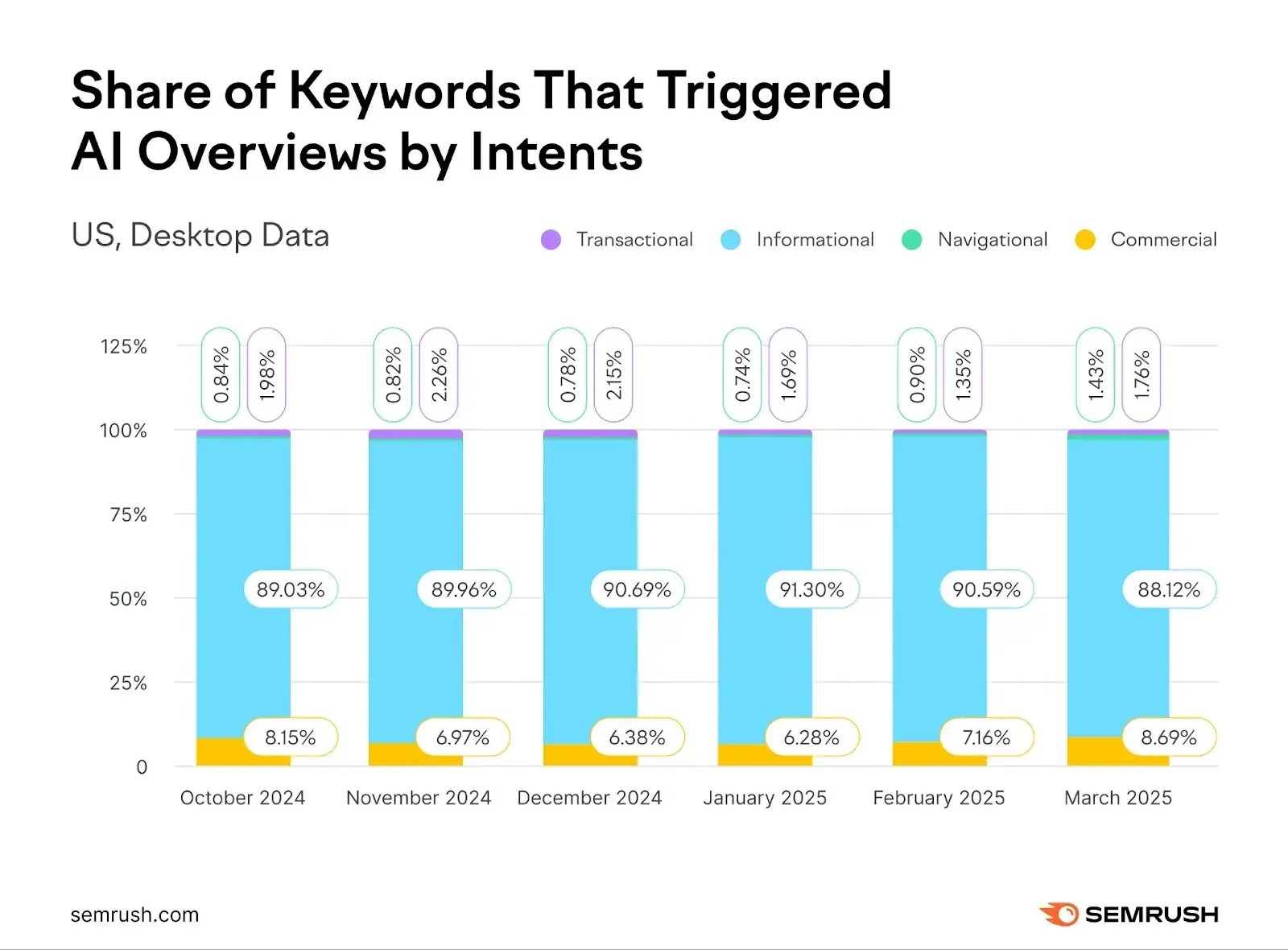
The result is pretty obvious: less clicks, but far more qualified ones – and far cheaper, too, since nearly all keywords (95%) included in LLM prompts or triggering AI overviews have either no paid ads or, according to SEMRush, “minimal commercial value.” Furthermore, those keywords classified as “commercially valuable” – defined as having a cost per click (CPC) above $2 – remain essentially untouched.
Compare that to the $5.20 estimated average for employment or career based keywords across industries (or around $12 per click for high intent traffic, like visitors coming from niche job boards), and the business case for rethinking the mechanics of recruitment advertising becomes pretty clear.
The issue is that employers seem largely stuck in this vicious cycle of paying too much for low intent or irrelevant traffic, both due to an unhealthy codependency on traditional job boards and search behavior, as well as the fact that most hiring funnels depend on volume as a way to compensate for inherent inefficiencies.
90-95% of most employers’ hiring funnels is simply noise; once AI starts removing that noise, however, organizations will have a much clearer picture of how well their talent attraction and recruitment advertising efforts are actually performing.
Spoiler alert: that clarity isn’t going to be particularly flattering, particularly if your budget has significant spend allocated to sites like Indeed, LinkedIn or traditional “programmatic” ad engines. Like much in recruiting, this exercise is probably going to be pretty unpleasant, but absolutely imperative when it comes to adding value to the business and the bottom line.
Underscoring this seismic shift in search activity is something more subtle; AI is actually expanding career discovery, rather than simply disintermediating or displacing it.
Research from the OECD and a variety of recent workforce studies have consistently shown that workers tend to underestimate or overlook their transferable skills, while having limited visibility into adjacent career opportunities or potential employers of choice. Traditional search, naturally, can’t really help with these use cases because they’re predicated on the assumption that users already know what to look for when entering a search query.
When it comes to careers, it’s fairly obvious that almost nobody really does. So, most continue to look for jobs, rather than discover careers. This is a huge miss for both employers and the candidates they’re looking to hire – but one that’s imminently correctable, and potentially hugely impactful.
The thing about conversational AI is that answer engines lower the barriers to exploration, and are engineered to allow users to start with some degree of uncertainty, while making refining and discovering relevant results far easier than traditional search engines. This not only changes the mechanics of career discovery, but creates an entirely new pool of potential, but passive, candidates who might otherwise never have engaged with job platforms or career sites in the first place.
This is a huge deal for talent acquisition – but one that, for some reason, recruiters and job platforms have largely swept under the rug. It’s easier to post and pray, after all, than to stop and challenge the status quo. The recruiting results, however, should prove well worth the effort.
Get Cash Back with Discovery.
The window of opportunity to get ahead of the career discovery curve, and the competition, is fairly limited – and the longer organizations wait to rethink the dynamics of recruitment marketing, the more diminishing the return on investment.
That’s because as the recruiting arms race shifts from job clicks to career discovery, and as AI search expands, the more cutthroat the competition will inevitably become. Within the next 18-24 months, you’ll not just be competing for the same candidates, but on a different channel. You’ll be competing in a totally different market, one that’s much larger, more fluid, and where expectations are being set by interfaces that are totally beyond any employers’ control.
Research suggests that, even in these early days, user expectations around AI discovery are already fairly codified and explicit. Looking for a job, like any online activity, will become integrated with, rather than distinct from, other online activities as LLMs become the default starting point for a growing majority of internet users (and, by extension, job candidates).
As the old saying goes, “candidates are consumers, and like all consumers, they have a choice.” Becoming, effectively, an employer of choice that more qualified candidates choose means remembering that finding a job follows the same discovery process as any other big ticket purchase online – albeit with much higher stakes than pretty much any other e-comm category.
That’s why it’s so important to remember, with the shift in user behavior moving from finding jobs to discovering careers, your career site will increasingly start to function like any digital storefront – not just a static landing page redirecting users to an ATS registration page (PSA: if your ATS requires a username and password for users to apply for jobs, you’re going to be even more screwed than you already are).
For your career site to function as the kind of store front that qualified buyers actually want to enter (as opposed to a warehouse with a ton of stale inventory, dated signage and obsolete infrastructure), then a critical first step is to bridge the widening expectation gap between top talent and talent technologies.
Candidates will increasingly expect personalization, because they use Amazon. They expect targeted recommendations, because they use Netflix. They expect speed, simplicity and relevance because every digital experience in their lives – besides looking for a job – is frictionless, painless and essentially instantaneous.
McKinsey research suggests that these expectations have become deeply entrenched across markets, industries and buying personas – and that failing to meet these expectations has an almost absolute correlation with whether or not an online sale is successfully completed or abandoned completely.
This is probably why 95% of career site traffic instantly decides against making a purchasing decision. In the age of “buy it now,” recruiting is still stuck operating a full service department store. No one wants to schlep down to Woolworth’s and pay full retail when they can get it faster, and cheaper, online.
The growing gap between those candidate expectations and recruiting reality is where candidate conversions die. But it’s also where most of the future opportunity exists in recruitment marketing and advertising – as long as employers prove ready to start treating their career site as anything more than an afterthought.
Job Boards Aren’t Dying. They’re Moving Downstream.
The idea that job boards are going to disappear is mostly wishful thinking (or “futurism,” if you’re a thought leader). Marketplaces that own workflow, ad inventory, maintain deep employer relationships and leverage proven application infrastructure will continue to be relevant – and a viable source of hire. This is particularly for high volume and hourly roles, which are far less dependent on discovery and more so on inventory.
Job boards will continue to exist; the most significant short term change we should expect to see is their position within employers’ TA Tech stack, as they inevitably move downstream, rather than positioned squarely at the top of the funnel. In this new recruiting reality, job boards become dependent not on referral traffic or paid ads, but instead, on upstream interfaces (like career sites or answer engines) for demand.
This shift should sound pretty familiar; it’s the same dynamic that’s fundamentally reshaped the landscapes of industries as disparate as media, ecommerce, travel and financial services. Broad aggregators, particularly ones who rely more on deduplication than differentiation, quickly become commoditized (see: Monster, CareerBuilder, The Ladders, etc).
Platforms that control workflow or experience, on the other hand – like Google for Jobs, or the native apply abilities of Indeed or LinkedIn (or Dalia, for that matter) – retain their leverage, and (mostly), their value.

For employers, this isn’t a hard choice to make, although it’s an essential one. Sure, TA teams can continue to optimize for volume and reward absolute traffic over qualified conversions while continuing to accept rising acquisition costs, declining marginal returns and increasing dependence on external vendors. Inevitably, some will.
But the winners in the future war for online talent will opt out of the status quo and instead choose the far more efficient, far more effective strategy: treating their career sites as the most controllable, most measurable, and most underutilized component of the entire front end of your hiring funnel.
Succeeding in making this shift, of course, means thinking in terms that recruiting has historically avoided: choosing conversion rates over applicant volume, prioritizing user experience over internal processes and policies and emphasizing personalization instead of generic, one size fits all career content.
Beyond this change in mindset, of course, employers have to recognize and acknowledge that their current processes and candidate journeys likely aren’t optimized for this new reality. Career site ownership is often heavily fragmented, under-resourced, or assigned to someone who has neither the mandate, nor the technical expertise, to treat it as a growth channel instead of employer brand collateral.
Making these changes in governance, and strategy, will take time. The bad news is that this is one problem that even AI won’t solve for you (and just might compound the problems, too).
Because when discovery happens outside of the narrow silo of job boards and proprietary platforms, and candidates don’t come through clicks but instead, with clear, career-focused intent, the delta between high performing experiences and broken processes can no longer be hidden behind vanity metrics like total traffic or applicant volume.
Which, frankly, is kind of the point, because in talent attraction today, no single platform or provider owns career discovery – and what used to be a vertically integrated process will only continue to fragment in the near future. Increasingly, AI operates as the exploration infrastructure, while most transactions continue to occur on job boards and marketplaces.
Employers, however, control the most important part of the process: the conversion layer. At least in theory; the real question is which organizations are actually prepared to capture value and optimize those conversions when it matters most, in real time, all the time.
Like the Crusades, winning the war for talent all comes down to driving conversions. But you can’t get to the Holy Land if your journey involves having to go through Byzantine processes. We’re still living in the Dark Ages, after all.
So, if you want to spend more time and more bandwidth arguing about source of hire data or justifying all that job board spend, then there’s plenty of vendor sponsored content out there for that. But if you’re more interested in figuring out how to convert the traffic you already have into actual hires, then I’d like to let you know about an upcoming webinar next week you won’t want to miss.
The Career Site Is the New Storefront: Register Now
On Tuesday, April 28 at 1 PM ET/10 AM PT, I’ll be moderating an executive level discussion with practitioners who have actually done the work of rethinking, and reinventing, what a career site can be: `
Michael Goldberg, Senior Director of Talent Acquisition Operations and Sourcing COE at US Renal Care, one of the country’s largest healthcare systems; Dalia co-founder, CEO and badass Sam Fitzroy, and recruitment marketing expert Carrie Corbin, co-founder and Managing Partner of Hope-Leigh Marketing, one of the top agencies in the industry.
This isn’t another abstract, highly theoretical conversation, product pitch disguised as “thought leadership” or a carefully scripted, sanitized and completely corporate B2B webinar. It’ll be a dynamic, candid and actionable discussion between people who actually do the work of running career sites at scale for massive brands – and who know that traffic was never the problem. It’s always been about conversion.
Give us an hour, and maybe we can convert you, too.

We’ll be discussing why career sites have become the most important decision point in the talent attraction process, how candidates today really evaluate employers and decide where to apply before ever talking to a recruiter or starting an application, and what high performing organizations do differently to turn career site visitors into qualified applicants efficiently and effectively enough to impact hiring outcomes and recruiting results.
So, if you’re responsible for attracting and hiring talent – and you’re still spending most of your budget driving traffic instead of converting it – this is one webinar you can’t afford to miss.
Register here and stop subsidizing a broken funnel.
Indeed, you can.
Pingback: Waarom in een tijd van A.I. je eigen recruitmentsite nóg belangrijker wordt - Werf&