The System is Broken: HR Technology and Trump
In the corridors of power, the companies that quietly manage paychecks, benefits, applicant tracking, and workforce data have randomly become some of the best-connected soft power peddlers in the Trump era, stepping into shoes previously occupied by private sector doyens Elon Musk, Maria Bartolomeo and the My Pillow Guy.
These enterprise technology executives are closely tracked and widely covered for what they do in Sun Valley, San Francisco or Saint Tropez (depending on the media outlet).
But make no mistake about it: what happens on K Street is as inexorably intertwined with HR Technology as anything that happens on Wall Street or Sand Hill Road. For some firms, maybe even more so.
For some reason, though, when it comes to their often copious political machinations and power peddling, it’s like DC is surrounded by a proverbial Beltway of Invisibility.
The politics of HR Technology, both at an enterprise and executive level, rarely makes headlines and almost always escapes the notice of their colleagues and customers.
But over multiple campaign cycles, their checks, lobbying campaigns and soft influence have done nothing less than entirely redesign the regulatory ground floor.
Between 2016 and 2024, HR and recruiting tech firms forged a sort of standard operating procedure, with a pretty simple and straightforward playbook: embed in transition teams, cultivate whisper networks, finance political actors, and ensure that rules never drift too far from their product roadmaps.

The Oracle of
When Donald Trump won in November 2016, Oracle made a bold bet. CEO Safra Catz joined the executive committee of Trump’s transition team in December 2016 while remaining at the helm of the company.
That move ignited internal turmoil. A veteran Oracle executive, George Polisner, publicly resigned in protest.
Catz’s alignment with the administration wasn’t just symbolic. She was floated for high-level federal appointments.
Meanwhile, Oracle co-founder Larry Ellison hosted a high-profile fundraiser for Trump in 2020 at his Rancho Mirage estate.
Following the election, Ellison joined a strategic call with Trump allies discussing efforts to challenge the result.
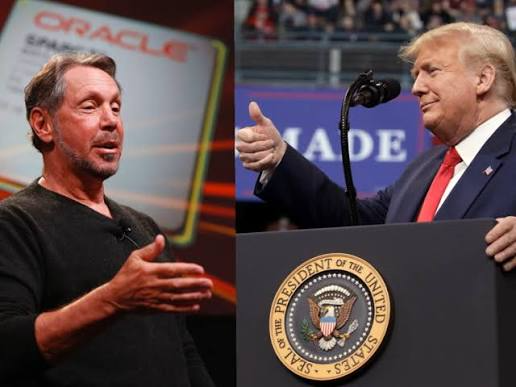
In 2025, Oracle was awarded the coveted role as TikTok’s U.S. data partner in a restructured agreement that many viewed as a political favor more than a technical necessity.
That’s obviously not entirely true – it’s not just a political favor, it’s a personal one, too.
Oracle gets IP that their lawyers can actively enforce and protect through onerous litigation, they don’t have to actually develop software and there is no data migration involved, or probably even possible.
On the plus side, we should all be very excited to see more photos of yacht racing, private Hawaiian islands and Paramount movie promotions on our FYPs.
Payroll Giants on Autopilot: ADP and Paychex
ADP and Paychex didn’t need splashy headlines. Their influence model was steady, strategic, and embedded deep in the bureaucracy.
ADP’s PAC and affiliated individuals donated generously to Trump and GOP lawmakers. Paychex, for its part, registered $810,000 in lobbying activity in 2024 alone.
During the pandemic, both companies positioned themselves as “CARES Act navigators”. They marketed compliance tools to employers, helping clients manage PPP loans and payroll credits while influencing IRS and Treasury guidance to favor their offerings.

The Recruiting & Staffing Ecosystem Slips In
Staffing and recruiting firms, often overlooked in political analysis, played a pivotal role throughout the Trump years. These firms, including national staffing agencies, RPOs, and VMS platforms, sit at the nexus of immigration enforcement, labor market flexibility, and employment classification policy.
Major players like Robert Half, ManpowerGroup, and Randstad leveraged lobbying arms like the American Staffing Association to stay engaged in regulatory debates.
Consequently, the ASA has submitted frequent comment letters on gig economy rules, H-1B visa restrictions, and independent contractor standards to the Department of Labor and IRS and similar policy issues.
As an aside, we can assume this industry association exists largely because most of its members can’t contact elected officials directly, since that would require sourcing accurate names and updated contact information.
To its credit, it’s actually taking public positions on policy issues, actively lobbying for its members and is focused on advocacy work that will benefit the industry and the profession. So, like the exact opposite of SHRM.
When Trump issued executive orders in 2017 targeting H-1B reform and launched the 2019 “Buy American, Hire American” initiative, staffing firms pushed back. They filed economic impact analyses and lobbied for carve-outs, particularly in states dependent on contingent labor.
On the tech side, VMS vendors like Beeline and SAP Fieldglass adapted platform rules to reflect evolving federal compliance demands. ATS platforms like iCIMS and Bullhorn raised their Beltway visibility by partnering on task forces organized by the National Association of State Workforce Agencies (NASWA).
While not every vendor had direct access to the White House, many benefited from proximity to enterprise clients and industry groups with their own policy leverage. As a result, the recruiting tech ecosystem became agile, responsive, and politically sophisticated.
MAGA in the Cloud: SAP and Workday’s Strategic Dual Track
SAP and Workday cultivated bipartisan credibility. In 2024, SAP spent $2.72 million on lobbying. Workday split its donations evenly across party lines, supporting both DNC and RNC-aligned candidates.
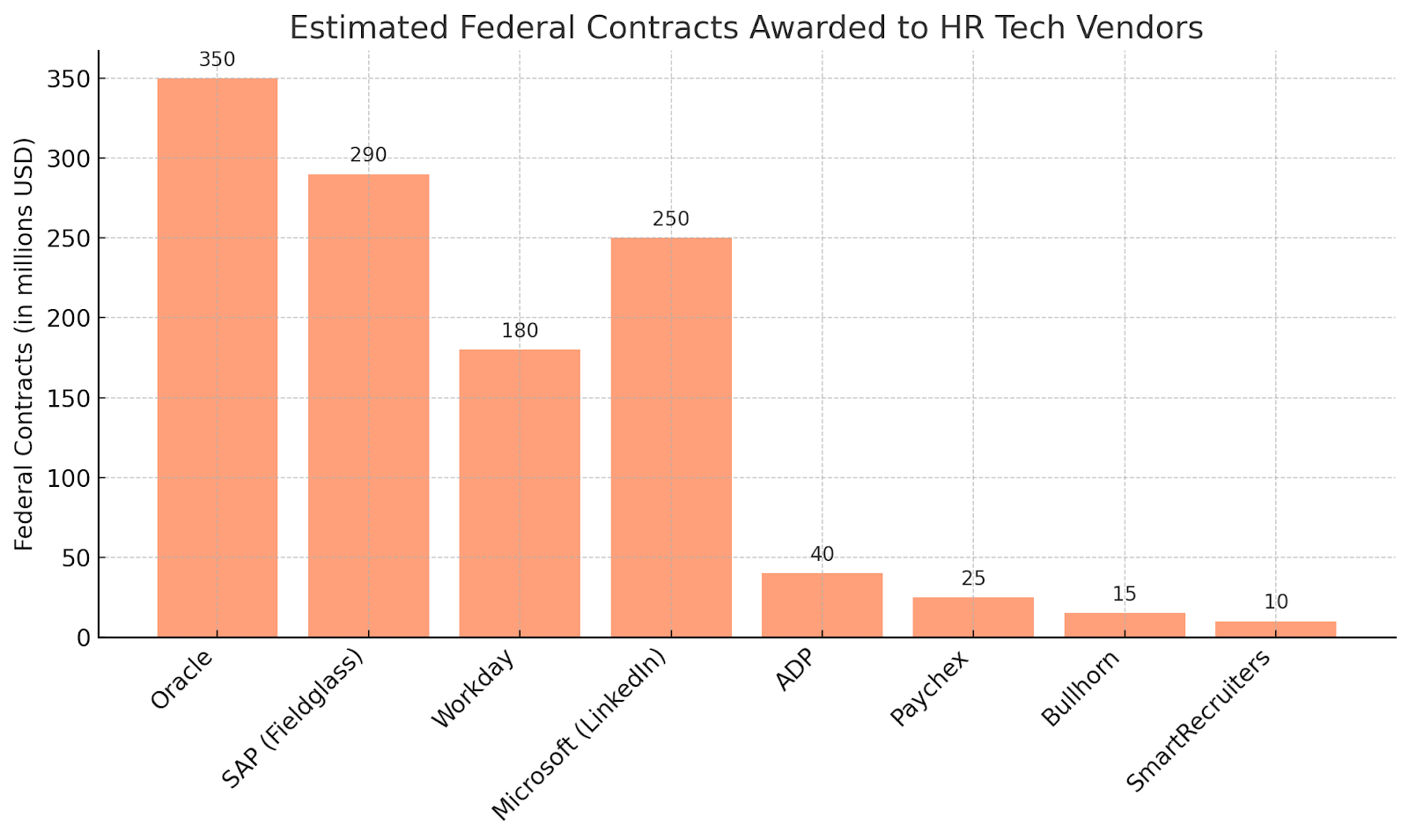
Both vendors secured federal contracts and softened the blow of regulatory shifts by remaining connected to both parties. Their lobbying focused less on ideology and more on continuity, enabling smooth sales to public-sector employers regardless of administration.

Artificial Intelligence and Algorithmic Influence
While the Trump administration never passed comprehensive federal AI legislation, HR tech vendors took full advantage of regulatory ambiguity.
Vendors like HireVue, Pymetrics, and Eightfold.ai positioned themselves as engines of public-sector efficiency. HireVue, in particular, received multiple state contracts for video-based assessments and joined federal workforce pilot programs. Until, you know,
While federal rules remained absent, vendors helped shape draft guidelines. They testified before Senate committees, collaborated with SHRM on ethics standards, and backed nonprofits like the Data & Trust Alliance to steer voluntary AI governance frameworks.
Microsoft, parent of LinkedIn, was particularly strategic. LinkedIn embedded itself in workforce retraining programs and White House tech initiatives, a perfect alliance between two entities whose approach to workforce and job market data is more an exercise in creative ideation than reporting accurate statistics.
While Microsoft publicly supported AI regulation, its resume parsing, job matching, and OpenAI investments proceeded with little oversight. Microsoft spent more than $10 million annually on lobbying, maintaining influence across labor, commerce, and tech policymaking circles.
Vendor Case Studies: Influence by Design
Case studies highlight how political access became product strategy.
Oracle’s TikTok deal is a case of transactional influence. ADP and Paychex turned themselves into Treasury whisperers, actively participating in comment cycles to shape tax guidance.
SAP’s Fieldglass helped federal agencies navigate gig worker rules. Workday’s expansion into state contracts was greased by bipartisan giving and coalition-building. Bullhorn and SmartRecruiters secured public-private reskilling grants.
LinkedIn’s job recommendation engine, used in multiple workforce pilots, went unaudited, yet was promoted by chambers of commerce and bipartisan task forces.
Global Contrast: How Other Markets Handle HR Tech Power
U.S. influence models stand in sharp contrast to peer nations.
In the European Union, GDPR mandates transparency around automated decisions and candidate data processing. Vendors must justify algorithmic hiring with human oversight, forcing a more cautious approach.
In Canada, public contracts are awarded via open RFPs with strict vendor neutrality. Companies like Ceridian and WorkJam have grown under these guardrails, without backchannel access.
Australia emphasizes industry group consultation over direct lobbying. HR tech influence is primarily routed through public advisory roles, not campaign finance or revolving doors.
The U.S., by contrast, enables vendors to shape employment law through lobbying, campaign giving, and policy co-authorship. In many cases, laws follow software—not the other way around.
Implications for the HR and Recruiting Professions
For HR leaders, vendor entanglement with politics poses ethical and strategic risks.
Tools marketed as “compliant” may be compliant because the vendor helped write the compliance standard. When vendors lobby to relax rules or define them, neutrality goes out the window.
Professionals must weigh dependence against autonomy. Should you trust platforms to interpret the law, or push for independent audits and third-party validation?
AI only compounds this problem. With limited federal guidance, HR professionals are becoming de facto regulators, making judgment calls on fairness, explainability, and disparate impact with little legal scaffolding.
Understanding the political behavior of HR tech vendors isn’t just parsing partisan tea leaves.
It’s how practitioners reclaim control in a system increasingly run by platforms that write the rules as well as the code.
Of course, no one in the industry probably cares about any of this, since if there’s one thing we’re used to in HR Tech, it’s broken systems that you’re powerless to fix, but are expected to tolerate.
Maybe, if you wait a few years, your patience will pay off and you’ll finally get a new and improved replacement system – or at least, an updated release.
Of course, no matter which system the consensus ultimately selects, it’ll still probably suck.
Just for slightly different reasons.
 Snark Attack