LinkedIn Hiring Assistant: Clippy Makes A Comeback

Somewhere along the line, the people who build HR tech stopped believing in recruiters. You can see it in every product launch dressed up as a breakthrough.
Every time a new AI “assistant” emerges, armed with autocomplete and the thinnest veil of generative AI, the implication isn’t subtle. It’s that recruiters are inefficient, inconsistent, and expendable.
That the problem isn’t a broken hiring system, it’s the humans still foolish enough to try to fix it. That, maybe, we’d all be better off if someone – er, something, just took over.
Which brings us to LinkedIn’s Hiring Assistant, which just expanded its availability globally after a year in pilot, just about long enough to grab some training data, create some customer success stories, generate some outcome data and package it all up in a product marketing bow.
It’s being framed as a milestone in recruiting automation. In practice, it’s more like Clippy got a makeover, learned how to parse job descriptions, and started sending templated InMails at scale.
It’s just as obnoxious as it sounds.
It’s the same playbook LinkedIn’s been running for a decade: add a layer of technology over a pile of user data and call it “insight.”
Only now, it’s AI. So everyone’s pretending it’s different.
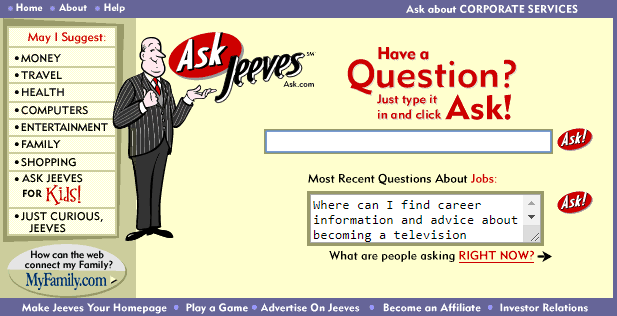
Jeeves Would Never.
Let’s start with the pitch: the Hiring Assistant promises to save you time, improve outreach, and screen candidates while you sleep. According to the product landing page, “Built on trusted, real-time data from 1+ billion members, Hiring Assistant delivers high-quality shortlists and uncovers candidates you’d otherwise miss.”
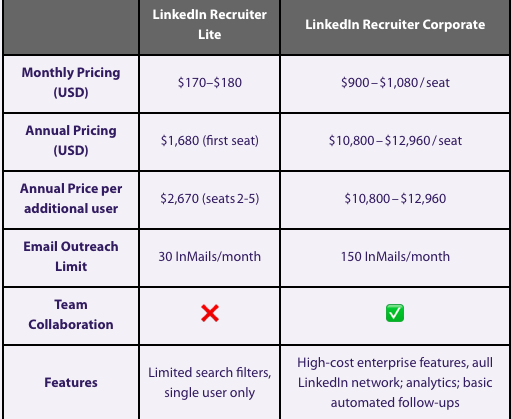
Great – so you’re telling all those customers who are currently paying between $10-12,500 US for a single LinkedIn Recruiter Corporate License every year that, guess what, your tool actually has some handy, dandy hiring shortcuts that aren’t included in that hefty price tag – and that you’re probably missing out on some great talent that’s already on LinkedIn, because their existing search and filtering capabilities definitely have some room for improvement.
But wait, there’s more! It can turn a vague, bloated job description into a “search query,” automatically match candidates based on “skills and competencies,” and even generate outreach messages that sound more “personalized.”
You know, because nothing says authentic human interaction like a predictive language model trained on the same content everyone else is using. According to LinkedIn, “early adopters” like the recruitment team at Jacobs, a civil engineering giant who reportedly hired 70 people in a single quarter using the tool, are thrilled.
They’re saving four hours per role, reviewing 62% fewer profiles, and somehow getting more people to respond to their InMails. Forget the glut of laid off federal employees who suddenly hit the market during this pilot at a company which counts national security, defense and public infrastructure projects among its biggest revenue sources.
Forget context. These stats sound great, right?
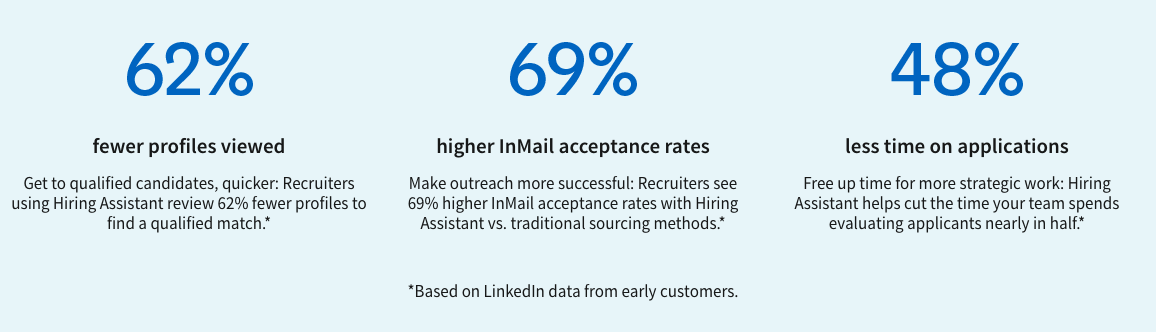
Sure. Until you realize this isn’t about making better hires – and LinkedIn tends to be a little, uh, hyperbolic about its outcome based data.
The tool is ostensibly about hiring faster, regardless of outcome – although most LinkedIn Recruiter customers know that hires are elusive on this platform, at any speed.
If You Want Better Recruitment, Stop Using LinkedIn
Thing is, we’ve been here before. Every decade or so, recruiting gets a new silver bullet: job boards, applicant tracking systems, programmatic ads, chatbots, Facebook Groups, whatever.
Each promises to eliminate the inefficiencies of human judgment. Each fails to account for the fact that recruiting is a fundamentally human function. Not because technology can’t help, but because the decisions that matter most, who to hire, who to ignore, who to risk, aren’t ones you can optimize with keywords and clickthrough rates.
But the real tell here is how little faith LinkedIn has in its own platform. The Hiring Assistant doesn’t actually reinvent anything. It just repackages features that already exist and wraps them in automation: Boolean search, filtered outreach, standardized screening.
These are tasks that a decent recruiter (or even a mediocre one) already knows how to do. What’s new is that now, you can do them without thinking about it.
Which is the whole point, and also the whole problem. Oh, but the good news is, no more InMail limits. Which is great news, right?
The Fundamental Flaw in Microsoft’s Dynamics
LinkedIn isn’t building tools to make recruiters better. It’s building tools to make recruiters unnecessary. Or more generously, it’s building tools for the people who never really wanted to do the work in the first place.
The overwhelmed hiring manager. The misanthropic HRBP. The founder trying to scale without hiring a full-time TA resource. For them, the appeal of the Hiring Assistant isn’t that it’s better than a recruiter. It’s that it’s cheaper than a full time recruiter, if not way, way more expensive than most other potential sources of hire (honestly, just go hire a search firm and save yourself some money).
That’s the real product LinkedIn is selling: it’s not AI, nor hiring efficiency; it’s all about plausible deniability.
A system that lets you claim you’re making data-driven, evidence-based, bias-free decisions while still relying on the same flawed assumptions and lazy shortcuts that got you so many views, but so few qualified applicants, the last time you bothered posting a req.
It’s the same system that somehow allows TA stakeholders to continue spending inordinate amounts of money on LinkedIn annual licenses; no one seems to need to question the foundational data, as long as that data validates their purchasing decision and looks pretty during QBRs and renewals.
Outlook Express: The Long Term for LinkedIn
Let’s talk about those assumptions for a second. According to LinkedIn, the assistant improves diversity outcomes because it “articulates which skills and competencies” led to a recommendation.
That’s not inclusion. That’s reverse engineering bias with prettier UX. If your job description is a mess (and most of them are), then optimizing that input only sharpens the knife. You’re not fixing the problem. You’re refining the algorithm that replicates it.
Even the “AI-enhanced” outreach is just lipstick on a lazy process. Auto-generated messages, no matter how cleverly phrased, are still auto-generated messages. You can call it personalization, but if everyone’s getting the same “thoughtful” note based on their profile, it’s just a more expensive form of spam.
And somehow, infinitely more obnoxious.
And the chatbot? Sure, it can screen candidates at night and enforce location requirements or eligibility checks. But you know what else does that? A checkbox. Or literally any ATS built in the last ten years. Except maybe Taleo Business Edition, which, in fact, does nothing.
This latest product play isn’t innovation. It’s outsourcing the most basic part of a conversation to a script that can’t ask follow-up questions. Yes – exactly like Clippy.
I’m not against automation. I’m just against pretending that more automation is always progress. Especially when it’s being used to justify the price point of a pretty mediocre, pretty overpriced and completely over commodified “platform.”
Hiring is already dehumanized enough. Job seekers don’t need another faceless interface pretending to care. They need clarity. They need feedback.
They need recruiters who actually read their applications instead of letting a machine pre-sort them by keyword density and graduation year.
Hasta La Windows Vista
What LinkedIn doesn’t seem to understand, or maybe just doesn’t care to admit, is that recruiting isn’t just a series of tasks to be completed. It’s a relationship. A negotiation. A series of micro-decisions made under pressure with imperfect information. It requires nuance, context, and instinct.
All the things AI, for all its power, still isn’t very good at. Could the Hiring Assistant help junior recruiters level up faster? Maybe. Could it help hiring managers draft better search queries? Sure.
But that’s not how it’s being sold. It’s being pitched as a replacement. As the next evolution of talent acquisition. As a way to “focus on what matters most” without ever defining what that actually is.
Here’s what matters: getting the right person into the right role at the right time.
Just Make the Damn Hire. Everything else is window dressing.
That’s maybe the most frustrating part of all this. LinkedIn ostensibly had the data, the network, and the market share to actually rethink what hiring could look like in the AI era. But instead, it built a (mildly) smarter inbox filter, although one that doesn’t actually catch most onsite spam, since it’s their primary revenue source.
Because what’s easier: disrupting the hiring process? Or just nudging it a little further toward apathy? Or getting enterprise buyers to shell out 7 figures for the privilege of training your data set (the latter is pretty low key smart, honestly).
Of course, we know the one thing they can’t do is build a salable ATS, tens of years and millions of dollars later (pour one out for the Hiring Hub). This is probably not the best sign for their AI ambitions, and one can assume that Microsoft is unlikely to park their top AI talent on what amounts to a peripheral business unit.
In the end, LinkedIn’s Hiring Assistant isn’t a revolution. It’s a regression disguised as innovation. A tool that treats hiring as a throughput problem rather than a human one.
And if we keep letting tools like this define the future of our profession, then maybe we do deserve to be replaced, after all.
 Snark Attack
Pingback: When Dinosaurs Ruled: Why the OpenAI Jobs Platform Could Be An HR Tech Extinction Event | Snark Attack
There’s such an opportunity for a Linkedin killer, especially in the SMB market. Forget Hiretual, Seekout, et al. Nobody wants yet another CRM that marries you into their $40,000/seat ecosystem when we already have Gem and Greenhouse. Not to mention Linkedin torched the trust of every rational user (or just me, maybe I’m the only one, idk) with their appalling AI writing assistant. I can’t believe anyone takes another AI product made by them seriously in the first place.
Just give me pure sourcing, their email address, and phone number. That’s all I ask.
Pingback: Buzzwords in Recruiting: A Survival Guide for 2026 | Snark Attack
Pingback: Transforming Recruitment Marketing: From Data to Insights | Snark Attack
Pingback: Eightfold’s Lawsuit: A Wake-Up Call for Talent Acquisition | Snark Attack