Employer of Record: Solution or Shell Game?

There’s a new acronym in town that every HR tech vendor is frantically adding to their pitch deck (and no, it’s not “AI”). It’s EOR, short for Employer of Record. Which is about as sexy as it sounds, if we’re being honest.
Here’s the basic pitch: you want to hire some hotshot engineer in Germany or a growth hacker in Brazil, but you don’t want to set up a legal entity, figure out foreign tax law, or accidentally trigger an audit.
EOR platforms, like Rippling, Remote, Papaya Global, Multiplier, and literally hundreds of other lookalikes, step in as the legal employer on your behalf, handling payroll, compliance, benefits, and all the messy bureaucratic stuff you’d rather ignore.
Sounds awesome, right?
Well, sure. That is, until you realize that what you’re really doing is paying a glorified middleman a premium to press “run payroll” in a country you don’t understand, using a compliance framework that may or may not hold up under actual legal scrutiny.
It’s A Small World of Work, After All
So how did we get here? The fact is, EOR is nothing new, and has actually existed for decades, usually in the fine print of staffing contracts or buried deep in international business consulting services agreements. Then, the concept was most commonly referred to as “outsourcing” or “offshoring” or some similar relic of the Reagan era.
But then COVID hit (remember?), everyone went remote, and suddenly every VC-backed startup wanted to hire “the best talent, anywhere.” Especially if “anywhere” meant not having to provide healthcare, a 401(k), or a livable wage.

Suddenly, global hiring wasn’t just for Fortune 500s with 10-person legal teams. It was for every seed-stage startup that raised a few million and needed to prove they could build a distributed team without knowing the first thing about employment law in Poland.
Enter the new EOR platforms: sleek, SaaS-y, VC-funded, full of promise and able to sell services at a SaaS multiple, which is getting pretty hard to do in these austere times.
“Hire in 150+ countries with one click” is a pretty salient pitch, after all – and without the negative connotations of old fashioned “outsourcing” or “offshoring,” albeit based on essentially the same business model of cheap labor at high margins.
What they don’t say is that you’re also entering a murky world of fragmented compliance, inflated fees, and contracts that might not protect you when things go sideways.
How Employers of Record Make Money
Spoiler: it’s not by saving employers money. Nope. Most EOR platforms operate on a simple but lucrative model – one that looks pretty damn compelling to VCs that base valuations on ARR and top line revenue.
From this perspective, EORs basically print money (or launder it, depending on the vendor):
- They charge you a monthly fee per employee, either flat rate or as a percentage of salary (usually 10-15%). That’s on top of the actual salary, benefits, and employer taxes.
- They pad the benefits costs with a nice little margin, since you can’t exactly go rate-shopping for health insurance in South Korea.
- They upsell you on “premium services” like visa sponsorships, equity plans, and legal support—because if you’re hiring globally, you’re already in over your head.
Multiply that by a few dozen employees across half a dozen countries, and suddenly you’re spending a fortune just to not own your own headcount.
Cool business model if you’re the EOR.
Less cool if you’re the startup trying to extend your runway – or, often, the customers they purport to serve, at margins best described as usury.
EOR: HR Solution or Shell Game?
This is where things get dicey. On the surface, EORs look like some sort of silver bullet for succeeding at scale. No local entity? No problem. Truth is, behind the curtain, it’s not always so clean.
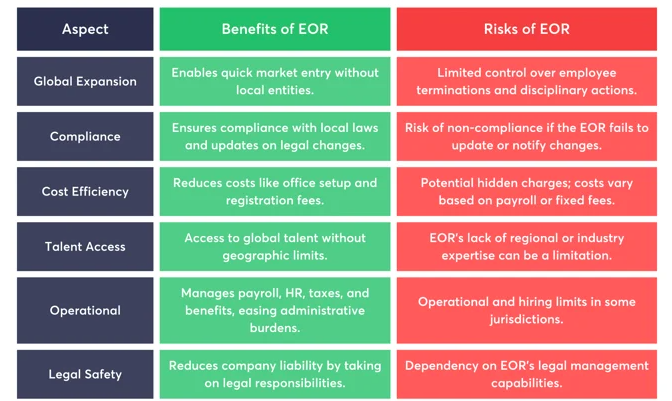
Let’s talk legal risk. In some countries, like Spain, only officially licensed staffing firms are allowed to do what EORs are effectively doing.
A recent EU ruling kind of, maybe, sort of said it’s okay—as long as the company isn’t exercising day-to-day control. Which is hilarious, because if you’re not managing your own employees, what exactly are you paying for?
Then there’s permanent establishment (PE) risk. If your EOR-hired team is generating revenue in-country or working under your direct control, you might still be liable for taxes and business registration.
The EOR will tell you they’ve got it covered. Your accountant will probably tell you otherwise.
Oh, and don’t forget vendor lock-in. Once you’ve got 30 employees on an EOR platform across five time zones, good luck ripping them out without blowing up your operations.
Switching EORs or bringing people in-house later is like breaking up with your payroll system mid-pay cycle—ugly, expensive, and potentially career-ending.

Make no mistake: this is a land grab (or gold rush, depending on the metaphor of your choice). The EOR market is projected to grow from $1.9 billion in 2022 to somewhere between $6 and $12 billion by 2028, depending on how many firms run out of cash or get rolled up into someone else’s HR platform.
Why? Because investors love a recurring revenue model. And EOR is just that: sticky, high-margin, subscription-style cash flow, attached to a fundamental business need—hiring.
But there’s a catch. Most of these vendors aren’t profitable. They’re burning through VC dollars to win market share, undercut each other on pricing, and fund expansion into new regions.
Eventually, that money runs out. When it does, expect consolidation, layoffs, and price hikes. And if your EOR goes under or gets acquired? Hope you’ve got a backup plan for your global payroll.
Should You Use an EOR?
Yes. Maybe. No. It depends.
But this is where nuance comes in, and nuance is not something you’ll find in a vendor demo. The thing about using an EOR is that it’s a great short-term workaround. It’s also terrible long-term strategy. The reasons are fairly simple.
Used properly, EORs are a fantastic short-term tool. They’re ideal for testing new markets, spinning up small teams quickly, or hiring a one-off specialist in a country where you have zero infrastructure. They can buy you time while you assess whether it’s worth setting up shop permanently.
But as valuable as employer of record services have the potential to be as a short term solution, they are not a long-term people strategy. They don’t scale well. They don’t support deep integration with your internal processes.
They create compliance risk the moment someone starts managing people, generating revenue, or building anything strategic. And they rarely play nice with your comp philosophy—especially if equity or incentive plans are part of your offer.
If you’re building a five-year plan that includes international growth, EOR should be your bridge, not your destination. You still need to build your house.
If you’re hiring one or two people in a new market and want to test the waters, EOR is perfect. It lets you move fast, stay mostly compliant, and avoid dealing with foreign bureaucracy. But if you’re serious about international expansion?
Set up an entity. Hire a local HR consultant. Own your people.
Because otherwise, you’re paying a premium for someone else to employ your employees—and that’s a weird kind of corporate bondage that looks a lot like flexibility (or “optionality,” if you’re a founder) until you try to scale.
At the end of the day, an EOR is just a fancy payroll processor with a global wrapper and a snappy UI. It’s not transforming work. It’s not redefining HR. It’s definitely not the future of employment.
What HR and TA Leaders Actually Need To Do
Look, you don’t need to be a global tax expert to navigate EOR. But you do need to be at the table. Because while the decision might start in finance or legal, the responsibility always ends with you.
And once those people are hired? You’re the one fielding the questions. About contracts. About promotions. About whether their local health plan covers IVF. About how to explain to their manager that they can’t get the same bonus structure as their peers in New York.
This isn’t a procurement problem. It’s a people problem (in as much as these are different concepts). And no amount of automation or “compliance infrastructure” is going to fix that for you.
Here’s what you can do:
Set clear guidelines: Define when EOR is acceptable and when it isn’t. Put boundaries in place for how long someone can stay on an EOR contract. Don’t let inertia dictate headcount.
Vet vendors carefully: Not all EORs are created equal. Some are just reselling local providers under a white-label brand. Others have no real legal infrastructure in the countries they claim to operate in. Ask hard questions. Demand transparency. They probably won’t give it to you. But it never hurts to ask.
Beyond that, just stay involved. If someone wants to hire abroad, make them explain the business case. Push back when the plan is to keep scaling indefinitely on a rented compliance framework. Speak up when the workforce strategy feels more like a growth hack than a real plan.
Because the risk isn’t that you’ll choose the wrong EOR. The risk is that you’ll forget why you needed one in the first place—and keep using it long after it’s outlived its usefulness.
So use it if you need it. After all, EORs are not going away. In fact, the market’s expected to grow into the billions in the next few years. But growth doesn’t equal value. And convenience doesn’t equal strategy. If your goal is to build a truly global team, then start thinking like one.
Invest in the right infrastructure. Understand the legal landscape. Localize your people strategy. Treat EOR as a stepping stone, not a shortcut. And the next time someone says, “Let’s just EOR it,” take a breath. Ask some questions. And remember: the person signing the paycheck might not be you.
But the person managing the fallout definitely will be.
 Snark Attack