
The Devil You Know: Do We Really Need HR Technology?
Posted on August 20, 2025 2 Comments
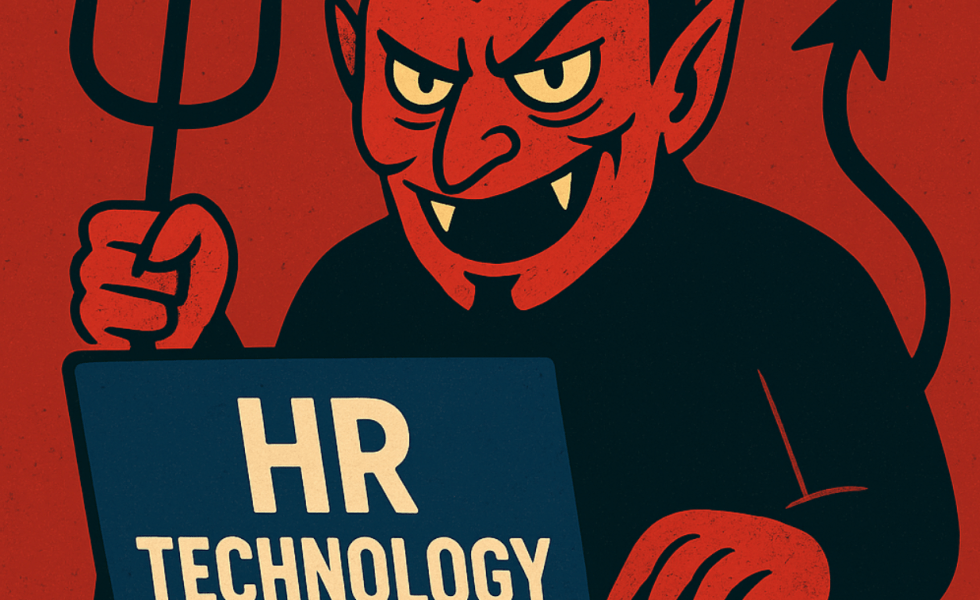
You’d think, billions of dollars and decades later, that by now, that HR would’ve figured out tech.
After all, SaaS has been the status quo for almost two decades, during which a global pandemic forced even the most analog of industries or conservative of functions to undergo an overnight “digital transformation,” which is what consultants used to call it back before it evolved from strategic initiative to tactical necessity.
Since SaaS became a ubiquitous part of our work (and our lives) back in the halcyon days of the first W administration, we’ve also undergone two major recessions, part of the perpetual, disruptive cycle of RIFs and rehiring that’s the natural byproduct of inept workforce planning and macroeconomic conditions.
We’ve seen the rise of the Gig Economy, the fall of the social contract and the collapse of DEIB as a core HR competency (unlike the first two, capitalism has no motivation to ensure its sustainability). We’ve seen the rise of crypto, the death of pensions and the dawn of general AI.
What we haven’t seen is any sort of tangible or meaningful change within the HR Technology industry, at least not compared to other categories.
Read MoreWhere We’re Going, We Don’t Need Roadmaps.
Posted on August 15, 2025 2 Comments

There’s a running joke in recruiting tech that every five years, the industry just puts a new buzzword on the same old pitch deck.
In the mid-2000s, back in the Certified Internet Recruiter days, it was “web-based,” then its groundbreaking derivative, “cloud enabled.” Sometime around 2010, the conversation shifted to “social recruiting.” 2015 marked the rise of “big data,” By 2020, we were all in on “DEIB.” Until, of course, we weren’t.
Now, we’re in the age of artificial intelligence, which, for most enterprise HR Tech vendors, means frantically bolting ChatGPT onto a 15-year-old code base and praying nobody notices the fundamentals still suck.
Among these legacy vendors making the shift from applicant tracking to artificial intelligence is iCIMS, a company whose very name, shorthand for “Internet Information Management Systems,” feels as outdated an anachronism as “mobile recruiting,” building Boolean strings or the latest version of Taleo Business Edition.
As its brand name seemingly suggests, iCIMS has long been a technology that CHROs tend to love and recruiters tend to tolerate, the Goldilocks of the ATS ecosystem: not too hot, but not too cold, either.
Maybe it’s not just right, but it’s certainly better than most of its upmarket incumbents, although lacking many of the features and functionality of more recent market entrants.
Read MoreSwagger Like Us: Why the Future of TA Belongs To Talent Intelligence
Posted on August 12, 2025 4 Comments

“Talent” and “intelligence” might be the ultimate oxymoron. It’s rare that these two seemingly divergent concepts don’t usually show up in the same sentence (at least, without irony).
For years, workforce decisions have been driven more by gut feel, outdated job descriptions, and whichever résumé floated to the top of the ATS that morning.
The result? Hiring managers still cling to irrelevant requirements like a toddler with a security blanket. Recruiters spend days chasing “passive candidates” who were never really interested in the first place. HR tries to predict future skill needs based on reports that were already outdated when they were published.
And then everyone acts shocked when critical roles sit open for months or top performers vanish overnight.
But here’s the truth: talent intelligence is not an oxymoron. And unlike “artificial intelligence,” it’s not some amorphous concept or meaningless buzzword. I know – my lack of cynicism towards this topic feels a little weird to me, too – but still.
Talent Intelligence (unlike, say, skills based hiring) is not only a real thing, but it’s also really important, too – in fact, it’s one of the most imperative capabilities a modern TA or HR function can have.
Read MoreThe Future of Work is A Lifestyle Choice.
Posted on August 8, 2025 1 Comment

At WeByte, we’re not building a company. We’re forging a movement. An ecosystem. A living, breathing quantum mesh of purpose alignment that occasionally ships product.
Some founders still insist people are the most important part of any startup. I disagree. People are the startup. And like any other startup asset, they should be properly leveraged, depreciated, and, when necessary, replaced with better, cheaper assets from the global market.
But let’s take a step back.
Read MoreEmployer of Record: Solution or Shell Game?
Posted on August 6, 2025 Leave a Comment

There’s a new acronym in town that every HR tech vendor is frantically adding to their pitch deck (and no, it’s not “AI”). It’s EOR, short for Employer of Record. Which is about as sexy as it sounds, if we’re being honest.
Here’s the basic pitch: you want to hire some hotshot engineer in Germany or a growth hacker in Brazil, but you don’t want to set up a legal entity, figure out foreign tax law, or accidentally trigger an audit.
EOR platforms, like Rippling, Remote, Papaya Global, Multiplier, and literally hundreds of other lookalikes, step in as the legal employer on your behalf, handling payroll, compliance, benefits, and all the messy bureaucratic stuff you’d rather ignore.
Sounds awesome, right?
Read More Snark Attack