Revamping High Volume Hiring Strategies

High volume hiring has always been the proverbial red headed stepchild of recruiting – a specialty that’s neither fully appreciated or understood, but easily and frequently forgotten.
The talent acquisition industrial complex has long skewed almost exclusively to high demand, low supply openings, the kind of knowledge workers who ask questions about total rewards, 401(k) matches and hybrid work arrangements.
These roles, after all, target mostly experienced, exempt and executive talent, the reqs a laundry list of minimum basic qualifications and pipe dream preferences whose market value tends to sit well over the hiring company’s comp range.
Sourcers like to refer to these as “purple squirrels,” and the chance to build Boolean strings and proactive pipelines is almost as exciting as developing an employer branding campaign to target this highly elusive, highly selective candidate population, or developing “personalized” messaging and outreach for unsolicited mass email campaigns.
These sinkholes of spend rarely lead directly to a successful hire (at least, one with clean attribution data), but these highly manual, highly customized and overly complex recruiting “strategies” tend to occupy between 90-95% of most talent organizations’ resources and recruiting efforts – and about the same percentage of recruiting and related thought leadership, trend analysis and best practices training.
The Essence of Essential Workers
High volume hiring, on the other hand, is more focused on process than personalization; more focused on operational efficiency than candidate conversion, and less concerned with finding “top talent” and more concerned with finding enough qualified candidates to meet and maintain at least the minimum staffing levels needed for the business to conduct business as usual.
These roles might not require a specialized certification, graduate degree or relevant industry experience, but they’re even harder to attract, hire and retain than the most in demand executive or technical talent on the market, across pretty much every market out there.
There’s a reason that these workers are the same who were deemed “essential” during the Pandemic – unlike salaried employees or knowledge workers, employers’ bottom lines are almost entirely predicated on front line talent.
These workers are just as elusive, if not more so, than their exempt counterparts, but every bit as critical to business continuity and delivery.
But they’re too often overlooked by the TA intelligentsia – an availability heuristic that’s in dire need of changing. The trade and academic press seems to eschew think pieces and microeconomic analyses of the high volume workforce.
There aren’t a lot of innovation awards or industry recognition programs out there to celebrate the people in the talent trenches who somehow managed to hire 10k warehouse associates in a single quarter, or who managed to temporarily double or triple the company’s standard headcount to offset seasonal demand in less than a month.
High volume hiring is the recruiting equivalent of indoor plumbing: everybody needs it, no one really thinks about it, and the moment it breaks, everything goes to hell.
Which might explain why, after years spent as little more than a marginal chapter in the bigger enterprise TA story, high volume hiring has emerged in 2026 as one of the most consequential, and competitive, battlegrounds in the proverbial war for talent.
This move from the TA margins to the recruiting mainstream has nothing to do with high volume hiring becoming increasingly imperative for business success, more highly scrutinized by executive leadership and more heavily commoditized by emerging tech solutions and professional services firms.
Forget Tech: The Real Talent Gap is Hourly Workers.
It’s not that the work has suddenly become sexier. It’s that the associated talent analytics have suddenly become a whole lot scarier.
Let’s take a quick dive into the data.
In its benchmark 2025 Future of Jobs Report, the World Economic Forum projected that frontline roles – jobs like delivery drivers, construction workers, retail salespeople, customer service reps and food service employees – will see the largest absolute growth in terms of overall job volume in the next 5 years, far outpacing any other professional category or sector.
We love to focus on industries like healthcare or tech or financial services in talent acquisition, but it’s not software developers, AI researchers, registered nurses or quantitative analysts that will see the biggest gains in short term job creation.
With apologies to the LinkedIn pundits or content marketers cosplaying as “thought leaders,” the most important growth drivers of the global labor market sit squarely in the middle of the old fashioned primary and secondary economies.
While they might not qualify as knowledge workers, employers with high volume hiring needs have the knowledge that it’s the work that happened on the frontlines that matters most in terms of what happens on their bottom lines.
The roles that keep the global economy running are also the fastest growing, and are the jobs that are the most dependent on recruitment infrastructure, process automation and scalable talent operation. In other words, the future of talent acquisition and the future of high volume hiring are inexorably intertwined.
As imperative as high volume hiring success has become for many of the worlds biggest employers and best known brands, it’s also the one recruiting discipline that’s the most underserved by the bigger talent acquisition industry – and the biggest opportunity for employers to optimize their hiring efficiency and efficacy.
High Volume Hiring Challenges? Indeed, You Do.
Indeed might be a pretty crap source of hire, but their sheer size and scale means that they’re a fairly reliable source for market data – and their recently released 2026 Jobs and Hiring Trends report paints a picture of a labor market that’s not so much frozen as impossibly fractured and increasingly fragmented.
Their benchmark Job Postings Index, a fairly reliable leading indicator of hiring activity, shows an overall decline in posting volume from around 10% above pre-pandemic levels at the start of 2025 to barely above 2% over pandemic era lows by the end of Q3, a precipitous and potentially perilous decline in overall job growth.
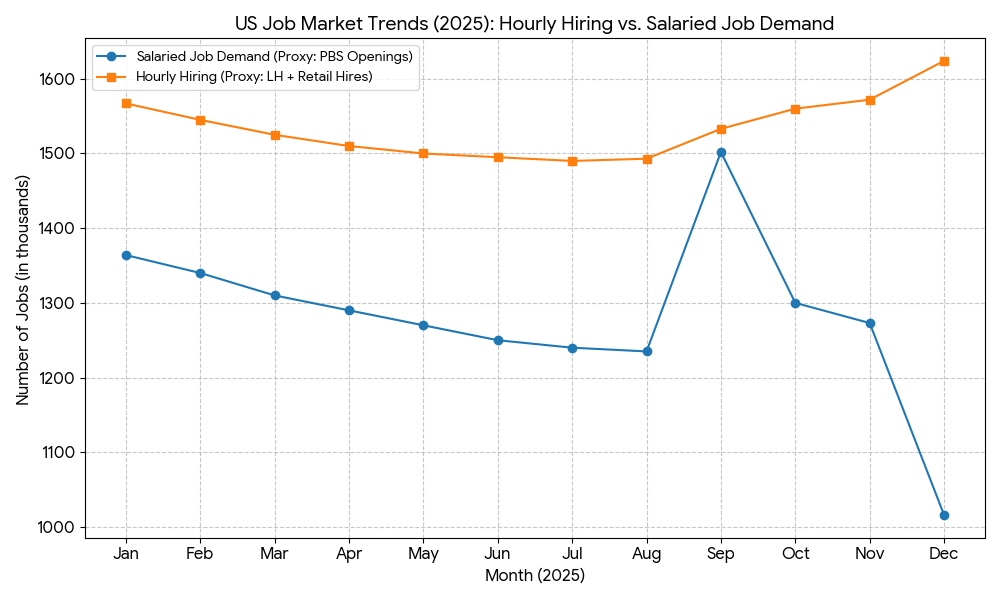
That declining demand, however, is far from uniform, with wildly divergent trend lines emerging that effectively suggest the growth of a bifurcated labor market – split between high growth (frontline, hourly roles) and slow death (pretty much every other job type).
For example, Indeed data shows that in 2025 alone, personal care and home health postings soared to 148.4 on Indeed’s Index (100 represents the average for aggregate posting volume), while media and communications roles cratered to a historic low of 64.1.
Simply put, the sectors that are the most heavily reliant on frontline workers and high volume hiring can’t find enough warm bodies to keep pace with increased demand, while exempt, professional “white collar” workers are facing a knowledge economy that’s already starting to crash.
The data shows that what we’re experiencing isn’t a labor shortage, nor a talent gap; rather, it’s a significant mismatch between worker supply and hiring demand, with high volume representing higher value to employers than ever before.
In recruiting, it is the best of times, it is the worst of times. And when it comes to high volume and hourly hiring, it’s time for organizations to finally start allocating the same resources and bandwidth to these workers as have historically been reserved for the kind of well paid, highly niche and esoteric roles that once commanded lucrative agency retainer fees or pricey, purpose built SaaS solutions.
Talent acquisition has entered a new era, but the good news is, the rules for effective recruiting remain effectively unchanged, even as the job market undergoes such seismic structural shifts.
Why AI is The Problem, Not the Solution
Yeah, I know what you’re thinking, but you can’t talk about hiring these days without also talking about AI, a topic that’s essentially ubiquitous (and gratuitous) in TA today.
I’m just as over it as most of you probably are, too, so trust and believe that for once, it’s not only relevant, but also imperative for understanding market dynamics, particularly the fundamental differences playing out in AI adoption and utilization between professional and high volume recruiting organizations.
For high volume hiring, speed is the most critical competitive advantage; “quality” is a secondary consideration, and generally synonymous with “reliable, professional and able to show up for shifts as scheduled.”
When you’re responsible for filling 500 open roles in a single distribution center in a tight time frame and with limited supply of available candidates, the difference between a 72 hour hiring process and the industry average two week time to fill can be the difference between profitable growth or abject failure.
They say time is money, and nowhere is that proverb more self evident than in high volume hiring, where a single unfilled job can cost companies millions of dollars in losses. This isn’t hyperbole; a shortage of one hourly worker is enough to stop assembly lines or to prevent products from shipping on time.
The constant demand to stay fully staffed, coupled with notoriously high churn rates and having to hire for hundreds or thousands of simultaneous openings is a big reason why frontline, hourly employers were also the earliest adopters, and most avid end users, of conversational AI and automated screening solutions.
Research has demonstrated that for frontline and hourly roles, the majority of candidates reported preferring process speed over personalization; they’re not looking for a human connection, and largely, don’t expect one during the job search process.
More than any other professional population, frontline workers are more likely to submit to AI screening and to embrace hiring process automation if it means knowing whether or not they got the job they originally applied for.
Pay matters far more than personalization, and quick hiring decisions and a frictionless process tend to be more effective at improving candidate sentiment and conversions than any employer branding collateral or career site copy.
This preference is different from experienced hires, who report preferring high touch over high tech after engaging with a respective employer; they’d rather find the company with the right fit then the fastest process.
This serves as a salient reminder that AI adoption, particularly when it’s candidate or consumer facing, is a more nuanced story than we’re often told – and employers should consider job seeker preferences and behaviors before lumping all AI enabled talent tech or workflows into a single narrative or strategy.
High volume hiring is, in many respects, something of an outlier compared to other recruiting specializations.
While many AI use cases fail to make a demonstrable impact in TA outcomes, repeated research studies and surveys have shown that for high volume, companies achieve significant improvements in outcomes like applicant conversion rates, time to fill, cost per qualified applicant and stakeholder management when leveraging AI in their hiring process.
At least, that’s according to the manifold vendor sponsored surveys, product marketing collateral and customer success stories proliferating in place of proper longitudinal studies and peer reviewed papers.
Shockingly, other market research and benchmark reports seem to suggest that this convenient narrative may be inconveniently misleading, statistically skewed or at least, more focused on the anecdotal than the analytical.
Of course, there’s always a catch – and this is one most product marketers and sales execs would rather not acknowledge.
Recent research has shown that cost per hire and time to fill have increased dramatically across the board over the past three years, a trend that seems to extend to high volume and hourly hiring, too – at least in aggregate.
This period of diminishing returns, of course, perfectly aligns with the proliferation of – and increasing reliance on – generative AI tools in recruiting and hiring.
The primary driver for this counterintuitive causation is what’s been referred to as the “AI Arms Race” (way less scary than the impending robotic arms race, for what it’s worth).
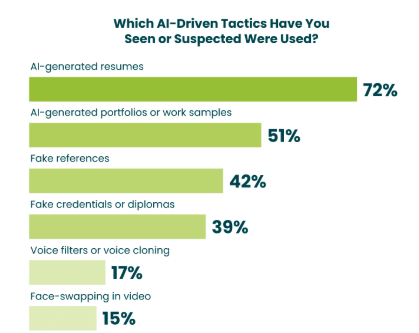
Candidates, as every recruiter is acutely aware of by now, have tried to reverse engineer automated hiring processes by using publically available LLMs to specifically tailor their resumes to match the verbiage and requirements of posted jobs, then using the same workflow tools to mass apply to seemingly every opening online.
Even in the most employer friendly of job markets, when applicants measure in the dozens rather than the thousands, most recruiters either don’t look at applicant resumes to begin with, or, more commonly, disposition them after a perfunctory scan of job titles and company names.
AI just reinforces this untenable signal to noise ratio at scale – and with so many applicants using so many tools to game the system, the flood of homogenized applications and Chat-GPT crafted cover letters paradoxically make screening candidates harder, not easier.
With research revealing an estimated 4 in 5 job seekers now leverage AI when applying for jobs, employers are getting thousands of applicants who look, on paper at least, more or less identical.
For high volume employers, whose heavy req load and relatively limited job related requirements already generate tens of thousands of applications per opening, this isn’t a technology problem – it’s an existential crisis. The challenge is compounded by the fact that the one use case AI can’t solve is finding signals in a sea of algorithmic slop. That hasn’t stopped employers from trying, though, and framing this Quixotic task as “digital transformation.”
Now, agents can automatically tilt at the windmills for you, apparently.
The Candidate Experience Conundrum
Here’s where the picture get a little murkier. Pew Research found that 66% of adults in the United States say they wouldn’t apply for any job utilizing AI hiring. And a whopping 71% (including, apparently, the FTC) oppose AI making final hiring decisions.
These numbers show a growing tension deleteriously impacting the current state of high volume hiring. Employers for frontline roles obviously function at such scales where automation is essentially required; however, using these technologies risk alienating a meaningful percentage of their potential talent pool.
High volume employers getting it right in 2026 understand that transparency and compliance are inherently different concepts. Compliance is, obviously, mandatory- generally, transparency isn’t, although it’s perhaps more critical for hiring success. After all, transparency isn’t a check box; it drives conversions and candidate confidence.
While the Eightfold case has yet to codify any case laws or legal precedents, in the interim, employers should tell candidates exactly where AI is involved, which decisions it drives and where, and when, humans intervene. This isn’t only the right thing to do, ethically speaking – it also has a material impact on candidate drop off.
Research shows that AI screening tools reduce resume review time by up to 75%, but only when candidates trust the process enough – and that process is frictionless enough- to actually complete the apply process.
And with 42% of candidates reporting they’ll abandon the hiring process when interview scheduling takes too long, the stakes for ethical, and effective, the stakes for getting automation in high volume hiring right have never been higher.
Started at the Bottom, And Still Here
The final trend that should terrify anyone responsible for high volume huring is the precipitous decline in entry level hiring. Recent research suggests entry level openings dropped a staggering 73% YoY in 2025 alone. The downstream effects from this drop off have ripple effects that can be felt throughout the entire labor market.
When employers slow hiring the emerging workforce for knowledge work or career track roles, it creates a significant backlog of well educated, but under employed, workers. In turn, this talent tends to flood into frontline roles, creating a surplus of overqualified candidates in high volume pipelines.
This is a mixed blessing for employers; this growing candidate pipeline has proven far likelier to ghost after accepting an offer, and when they do, they’re much more difficult to retain than more traditional frontline talent.
According to benchmark research from Gartner, offer acceptance rates for hourly workers has declined from around 75% to just over 50% in the past two years alone – a trend that looks likely to continue accelerating over the coming months.
High Volume Hiring, Without the Fairy Tales
I’ve been watching this industry long enough to know the perils of chasing shiny new tools and tech while largely ignoring the underlying infrastructure issues impacting recruitment outcomes.
That’s why I can pretty confidently assert that in 2026, high volume hiring isn’t going to be fixed by some next-gen chatbot (er, “conversational intelligence”) or another slick employer brand video featuring drone footage of corporate campuses or employee testimonials that sound suspiciously like company propaganda.
High volume hiring has never been more challenging, and the organizations that survive – and thrive – in this market won’t be the ones doing AI case studies or conference keynotes on the tech that turned around their frontline talent acquisition initiatives.
The winners will be those employers who sweat the small stuff, and commit to the imperative, albeit kinda boring, work of integrating and configuring their talent tech stack to eliminate siloed and friction; creating scalable, transparent candidate experiences that build trust rather then erode it, and investing in talent operations instead of talent attraction or new technologies.
If you’re responsible for high volume hiring- or are looking for ways to uplevel and future proof your high volume recruitment strategies- then you need to register for today’s recruiting roundtable, “High Volume Hiring Without the Fairy Tales.”
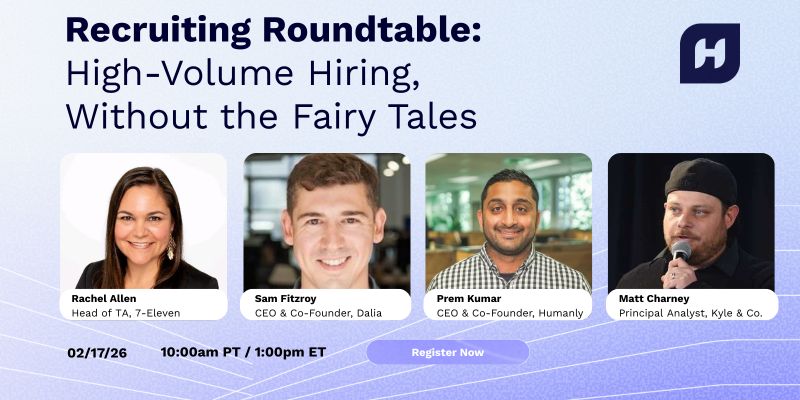
I’ll be joined by frontline recruiting experts Rachel Allen, Senior Director of Talent Aquisition at 7-11; Prem Kumar, founder and CEO of Humanly; and Sam Fitzroy, the founder and CEO of Dalia. PS: they’re all badasses, and know their stuff. So, this should be pretty fun.
We’ll be digging into what’s working in frontline hiring today, what’s not, and what real recruiting leaders can really do to ensure a scalable, sustainable high volume recruitment strategy.
There won’t be any vendor pitches, recycled conference content or thinly veiled product marketing (promise) – just a real conversation about what’s new, what’s next and what you need to know about high volume hiring to meet demand- and beat the competition.
Register now for today’s exclusive roundtable at 1 ET/10 PT here: https://luma.com/btpasse
Can’t make it live? No worries; we’ve got your back. Register now and we’ll send a full recording straight to your inbox. Because moving the needle on high volume hiring won’t wait for your next QBR. And, frankly, neither will your candidates.
Hope to see you there.
 Snark Attack